Kinetics of radioactive decay
Radioactive decay law
- Radioactive atoms decay at a rate proportional to the number of radioactive atoms present.
Equation
- −dN/dt = λN
- A = λN (activity = decay constant × number of atoms)
- N is the number of radioactive atoms, and λ is the decay constant of the radionuclide: the fraction of atoms that decay per unit time.
- The unit of λ is (time)⁻¹, for example s⁻¹ or h⁻¹.
- The disintegration rate (−dN/dt) is called the activity (A) of the radionuclide.
- Solving the equation gives the exponential decay law, where A0 is the activity at time zero.
Equation
- At = A0 e−λt
Half-life
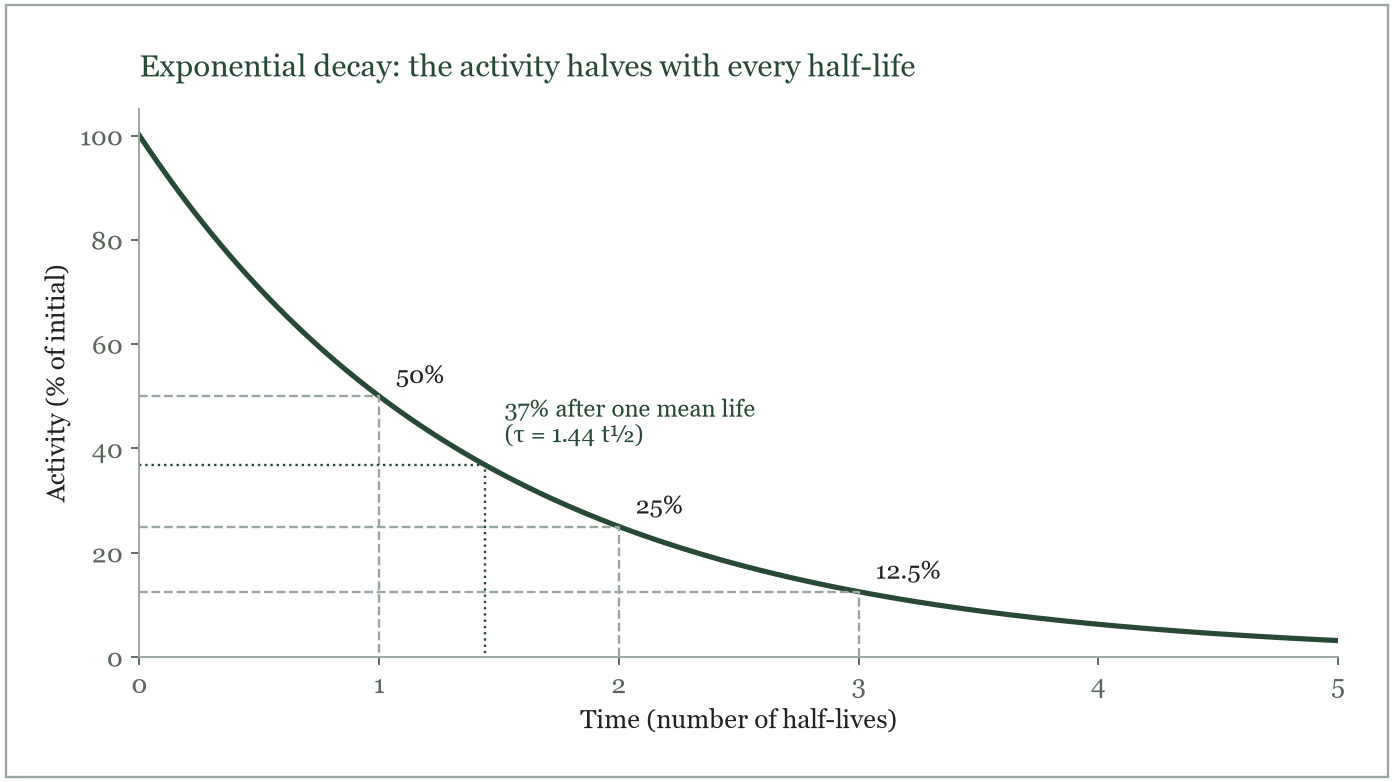
- The physical half-life (t½) is the time taken for the activity of a radionuclide to fall to half its initial value.
- Each radionuclide has its own unique half-life.
Equation
- λ = 0.693 / t½ (0.693 = ln 2)
- After n half-lives, the activity left is A0/2n. After 10 half-lives, about 0.1 % remains.
- Example: 740 MBq of ⁹⁹ᵐTc (t½ 6 h) falls to 185 MBq after 12 h (two half-lives).
Mean life
- The mean life (τ) is the average lifetime of the atoms in a radioactive sample.
Equation
- τ = 1 / λ = t½ / 0.693 = 1.44 t½
- After one mean life, the activity has fallen to 37 % (1/e) of its starting value.
- Example: for ⁹⁹ᵐTc, τ = 1.44 × 6.01 h ≈ 8.7 h.
Effective half-life
- The physical half-life (Tp) is the time for the activity to fall by half through radioactive decay alone. It is a property of the radionuclide and is the same inside or outside the body.
- In the body, a radiopharmaceutical is also cleared exponentially through urine, faeces, sweat and other routes. The time for half of it to be eliminated is its biological half-life (Tb).
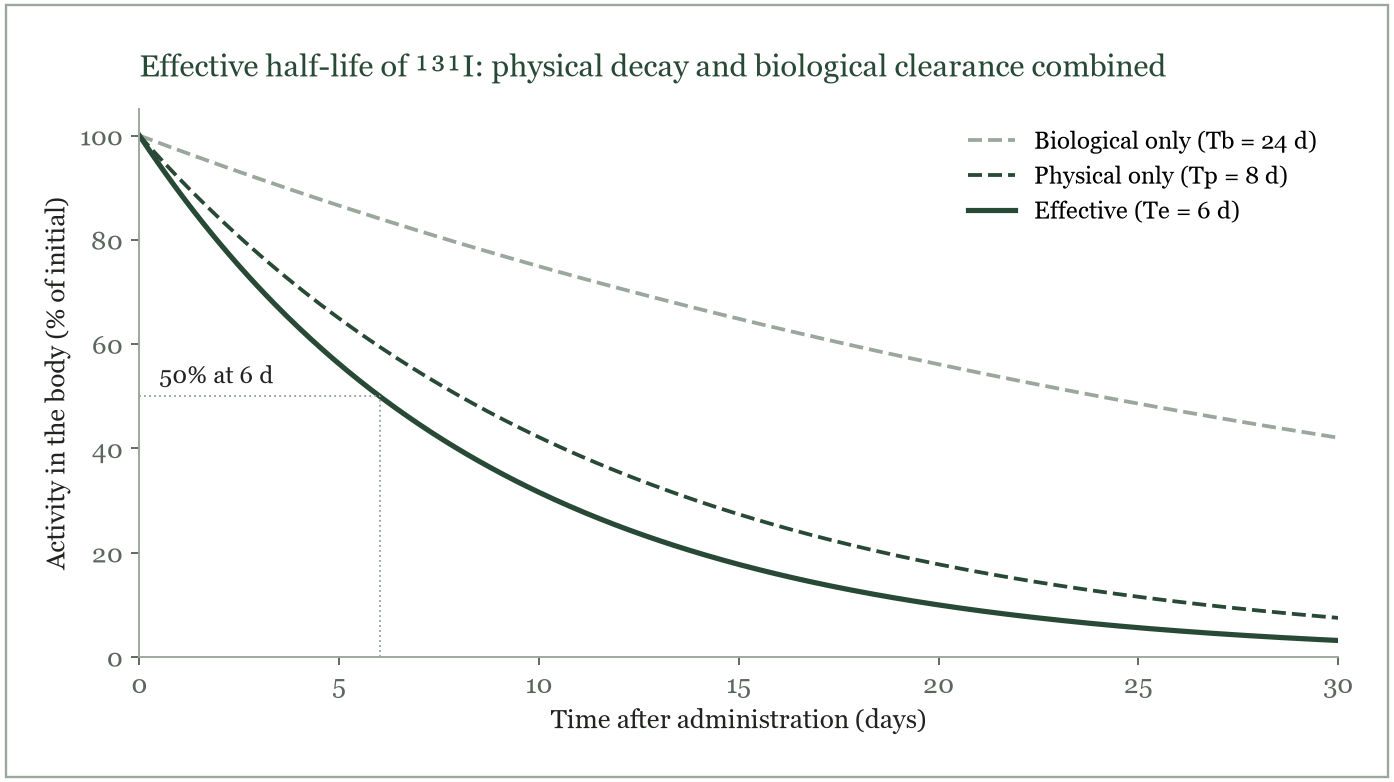
- In a patient, activity is lost by both routes at once.
Equations
- λe = λp + λb
- 1 / Te = 1 / Tp + 1 / Tb
- Te = (Tp × Tb) / (Tp + Tb)
- The effective half-life (Te) is always shorter than the shorter of Tp and Tb.
- If Tp is very long and Tb short, Te ≈ Tb. If Tb is very long and Tp short, Te ≈ Tp.
Example
- ¹³¹I: Tp = 8 d, Tb = 24 d
- Te = (8 × 24) / (8 + 24) = 6 d
Specific activity and concentration
- Specific activity is the activity per unit mass of a radionuclide or radioactive sample, for example MBq/mg.
- For a labelled compound, it is often given per mole, for example MBq/µmol.
- Concentration is the activity per unit volume of a sample, for example MBq/mL.
- A carrier-free sample contains only the radioactive atoms of that element, with no stable atoms of the same element mixed in.
- Its specific activity follows from A = λN. Per gram of the nuclide, N is Avogadro's number divided by the mass number A, and λ is 0.693/t½.
Equation
- SA (per gram) = λ × NA / A = 0.693 × NA / (t½ × A)
- So two things raise the specific activity: a short half-life (each atom decays sooner, so more decays per second) and a low mass number (lighter atoms, so more atoms in every gram).
- Example: ⁹⁹ᵐTc (t½ 6.0 h, A 99) has a specific activity of about 1.9 × 10¹⁷ Bq/g; ¹³¹I (t½ 8.0 d, A 131) about 4.6 × 10¹⁵ Bq/g, roughly 40 times lower, mainly because its half-life is 32 times longer.
- In practice, generator ⁹⁹ᵐTc is not quite carrier-free: it contains some ⁹⁹Tc from decay, so its real specific activity is lower.
Parent–daughter equilibrium
- When a radioactive parent decays to a radioactive daughter, the daughter's activity builds up and then settles into a fixed relationship with the parent. This is called equilibrium.
Transient equilibrium
- Occurs when the daughter's half-life is shorter than the parent's (λd > λp), with the two half-lives differing by a factor of about 10–50.
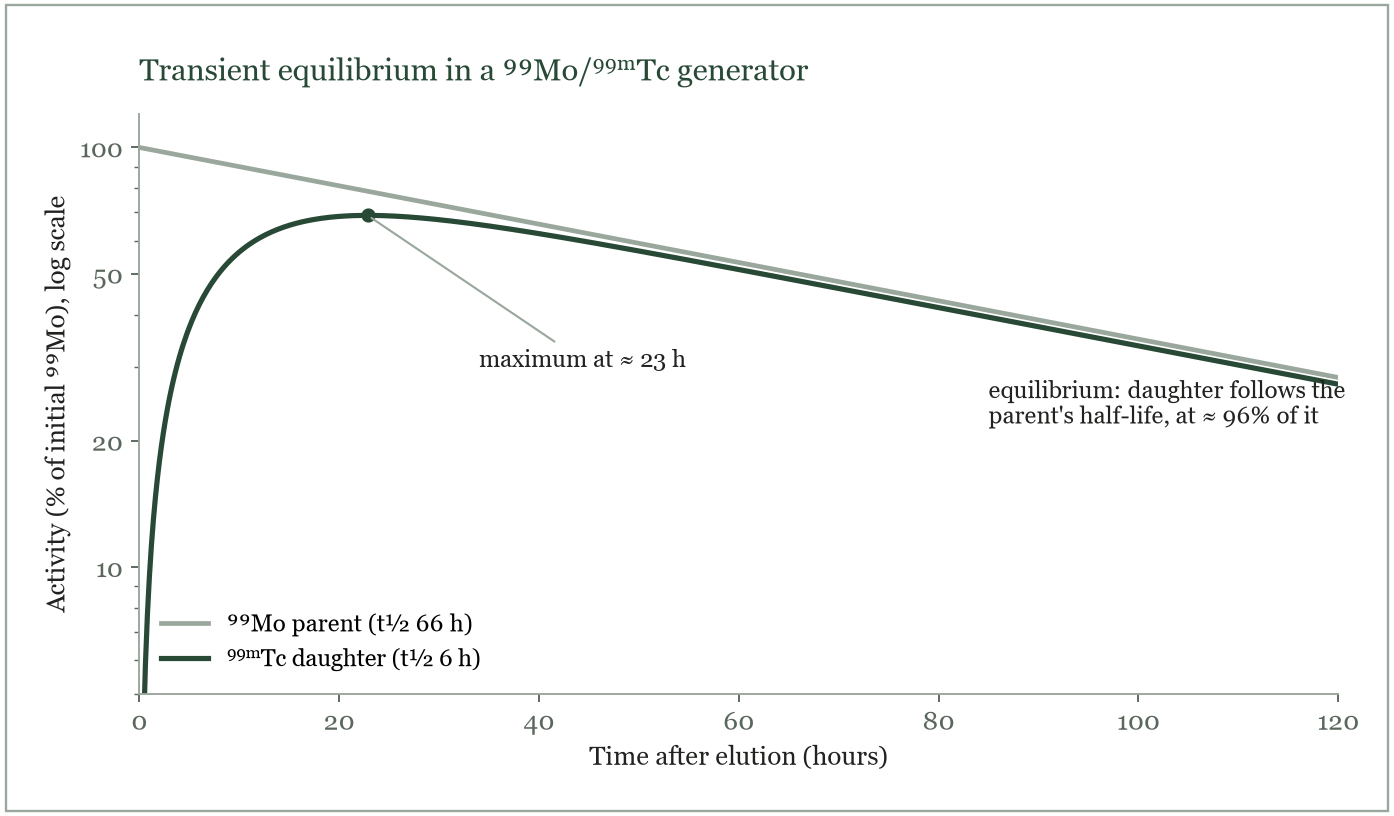
- The daughter activity first builds up, reaches a maximum, and then decays with the apparent half-life of the parent.
- At equilibrium, the ratio of daughter to parent activity stays constant.
- If all parent decays feed the daughter, the daughter activity exceeds the parent activity, because the ratio (t½)p / [(t½)p − (t½)d] is greater than 1.
- Example: ⁹⁹Mo (66 h) → ⁹⁹ᵐTc (6 h). ⁹⁹ᵐTc activity reaches its maximum about 23 h after elution.
- Only about 87.6 % of ⁹⁹Mo decays produce ⁹⁹ᵐTc, so in equilibrium the ⁹⁹ᵐTc activity is slightly lower than the ⁹⁹Mo activity, about 96 % of it.
- This is the basis of the daily elution of a ⁹⁹Mo/⁹⁹ᵐTc generator.
Secular equilibrium
- Occurs when the parent's half-life is much longer than the daughter's, by a factor of more than about 100 (λd ≫ λp).
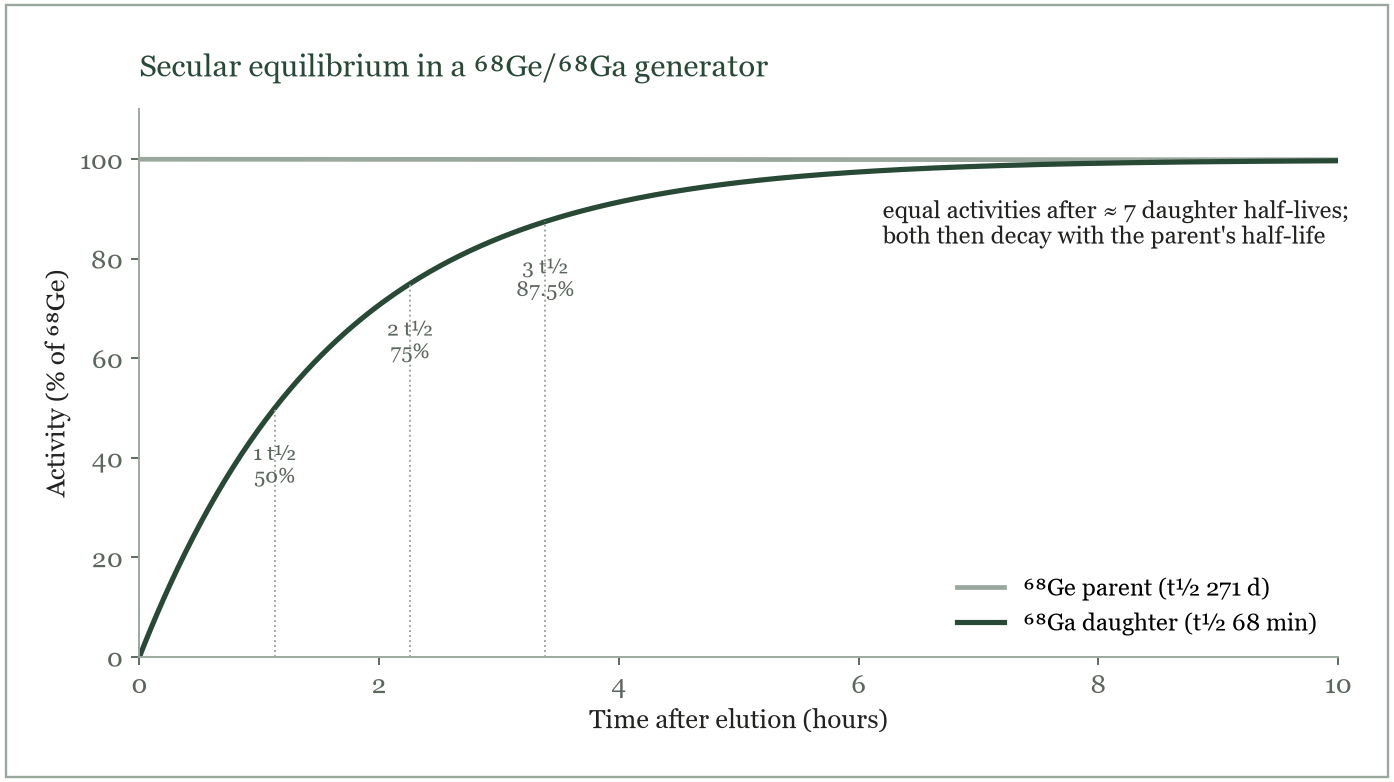
- In secular equilibrium, parent and daughter activities become equal, and both decay with the parent's half-life.
- Equilibrium is reached after about 7 daughter half-lives.
- Examples: ⁶⁸Ge (271 d) → ⁶⁸Ga (68 min); ⁸²Sr (25 d) → ⁸²Rb (75 s).
Test yourself
Revise this chapter with the Kinetics of decay deck in Flashcards.
10 quick questions. Pick an answer to see the explanation.
1. Which equation is the radioactive decay law?
Answer: B. Activity falls exponentially with time: At = A0e−λt.
2. The half-life of a radionuclide is 6 h. What is its decay constant?
Answer: B. λ = 0.693/t½ = 0.693/6 = 0.116 h⁻¹.
3. A vial contains 800 MBq of ⁹⁹ᵐTc (t½ 6 h). How much remains after 18 h?
Answer: C. 18 h is three half-lives: 800 → 400 → 200 → 100 MBq.
4. What fraction of the initial activity remains after one mean life?
Answer: B. After one mean life (1.44 t½), activity is 1/e of the start, about 37 %.
5. A radiopharmaceutical has Tp = 6 h and Tb = 3 h. What is its effective half-life?
Answer: A. Te = (6 × 3)/(6 + 3) = 2 h.
6. Which statement about effective half-life is correct?
Answer: C. Both physical decay and biological clearance remove activity, so Te is shorter than either.
7. Which carrier-free radionuclide has the highest specific activity?
Answer: B. For carrier-free nuclides, SA ∝ 1/(t½ × A): short half-life and low mass number give the highest SA.
8. Transient equilibrium occurs when the parent half-life is longer than the daughter's by a factor of about:
Answer: B. Transient equilibrium needs half-lives differing by roughly 10–50 times, as for ⁹⁹Mo/⁹⁹ᵐTc.
9. Why is the ⁹⁹ᵐTc activity in a generator slightly lower than the ⁹⁹Mo activity at equilibrium?
Answer: B. About 12 % of ⁹⁹Mo decays bypass ⁹⁹ᵐTc, so the daughter settles at about 96 % of the parent activity.
10. In secular equilibrium, which is true?
Answer: B. With a parent much longer-lived (>100×), the daughter activity equals the parent's and follows its half-life.
References
- Saha GB. Physics and Radiobiology of Nuclear Medicine. 4th ed. New York: Springer; 2013. Chapter 3.
- Cherry SR, Sorenson JA, Phelps ME. Physics in Nuclear Medicine. 4th ed. Philadelphia: Elsevier Saunders; 2012.
- National Nuclear Data Center, Brookhaven National Laboratory. NuDat 3: evaluated nuclear structure and decay data.
Spotted an error or something out of date? Report an error