Contrast Media in Hybrid Imaging
The CT in SPECT/CT and PET/CT is usually low-dose, for attenuation correction and localisation. Iodinated contrast is added only when a diagnostic CT answers part of the clinical question. The usual precautions apply: kidney function, previous reactions and hyperthyroidism. Two more are specific to nuclear medicine. Iodine blocks radioiodine uptake for weeks, and dense contrast can bias CT-based attenuation correction.
European (ESUR) and American (ACR) guidance agree that modern non-ionic iodinated contrast is safe for most patients, including those taking metformin with eGFR ≥30. They differ on premedication after a previous reaction and on the wash-out interval before radioiodine; both views are given below.
- Kidney risk (ESUR v10 and 2025): eGFR <30 mL/min/1.73 m² before IV contrast; <45 before intra-arterial contrast with first-pass renal exposure or in ICU patients. ACR 2024: prophylaxis indicated for AKI or eGFR <30.
- When to measure eGFR (ESUR): within 7 days for inpatients or acute illness; within 3 months for everyone else.
- Metformin (ESUR; ACR): continue if eGFR ≥30 and no AKI. Stop at the time of contrast if eGFR <30, AKI, or intra-arterial first-pass exposure; recheck eGFR at 48 h before restarting.
- Prophylactic hydration for at-risk patients (ESUR): IV sodium bicarbonate 1.4% 3 mL/kg/h for 1 h before, or IV 0.9% saline 1 mL/kg/h for 3–4 h before and 4–6 h after contrast.
- Previous moderate or severe reaction: ESUR v10 — use a different agent, ideally after allergy review; premedication not recommended. ACR 2024 — prednisone 50 mg orally 13, 7 and 1 h before plus diphenhydramine 50 mg 1 h before, or methylprednisolone 32 mg 12 and 2 h before.
- Before radioiodine: ESUR v10 — no iodinated contrast for 2 months before therapy or thyroid imaging; ACR — wash-out 3–4 weeks (hyperthyroid) or 6 weeks (hypothyroid); ATA — 4–8 weeks.
- Bone scan and red-cell labelling: avoid iodinated contrast for 24 h before the study (ESUR v10).
- Breastfeeding continues normally after iodinated contrast (ESUR; ACR).
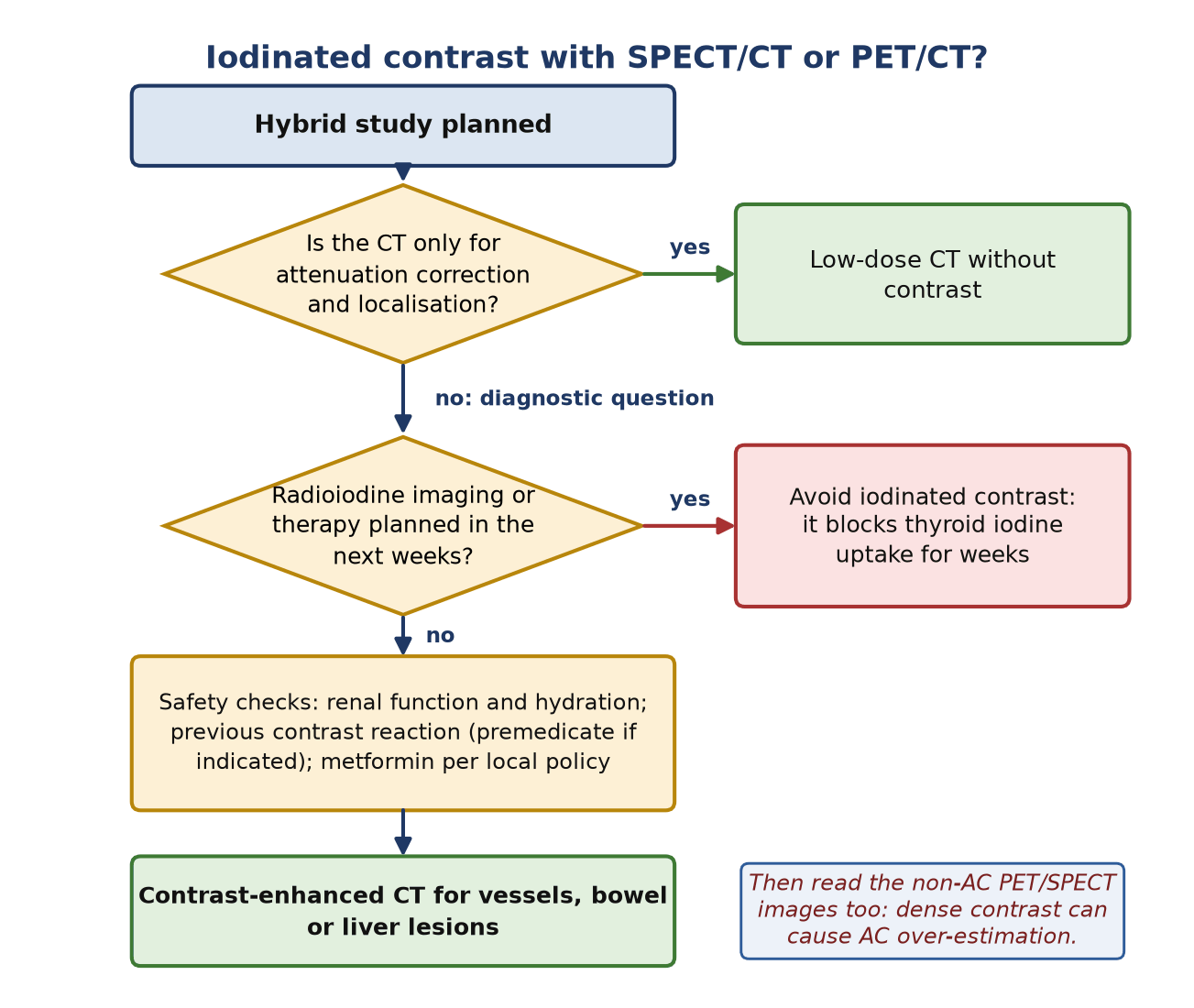
When to use contrast
- Use it for diagnostic problem-solving beyond localisation: vessels, bowel, liver and other solid-organ lesions, or when one contrast-enhanced PET/CT replaces a separate staging CT.
- It is not needed when the CT serves only for attenuation correction and anatomical localisation.
- Weigh the extra information against the added CT dose, the contrast risk and interference with radioiodine or other tests.
- Oral contrast: if SUVs will be quantified, use only diluted positive agents or water (EANM FDG v2.0).
Safety checks
- Kidney function: measure eGFR in all patients, or in those with kidney disease, kidney surgery, proteinuria, hypertension, hyperuricaemia or diabetes. Risk of contrast-associated acute kidney injury rises below eGFR 30 for IV contrast. Hydrate at-risk patients; oral hydration alone is not adequate (ESUR).
- Metformin: continue if eGFR is ≥30 with no AKI. Otherwise stop at the time of contrast and restart after eGFR is rechecked at 48 h. This eGFR-based rule supersedes the older blanket 48-h stop still quoted in some procedure guidelines.
- Previous reaction: the two guidelines differ. ESUR advises a different contrast agent, an allergy referral and no premedication, because evidence for premedication is poor. ACR recommends a 12- or 13-hour steroid regimen for prior moderate or severe reactions. Shellfish or other unrelated allergies are not an indication (ACR).
- Thyroid: do not give iodinated contrast in manifest hyperthyroidism or thyroid storm. Monitor patients at risk of iodine-induced thyrotoxicosis, such as those with untreated Graves' disease or multinodular goitre with autonomy (ESUR; ACR).
- Be ready for acute reactions: the first-line drug for anaphylaxis is intramuscular adrenaline 0.5 mg (1:1,000) in adults. Keep patients in a medical environment for 30 min after injection (ESUR).
Interactions with nuclear medicine
- Iodinated contrast floods the iodide pool and blocks thyroid uptake of radioiodine. Book radioiodine imaging or therapy before contrast CT where possible; after contrast, wait 2 months (ESUR v10), or 4–8 weeks (ATA), with urinary iodine if in doubt. Urinary iodine returned to baseline within 1 month in a study of post-thyroidectomy patients.
- Avoid iodinated contrast for 24 h before a bone scan or red-cell labelling (ESUR v10).
- Pregnancy: contrast crosses the placenta; if it is given, check neonatal thyroid function in the first week (ESUR).
- Gadolinium for PET/MR: in pregnancy only a macrocyclic agent at the smallest dose and only with a very strong indication; breastfeeding continues normally after macrocyclic agents (ESUR).
Pitfalls
- Dense contrast (a bolus in the SVC or subclavian vein, or concentrated oral contrast) is read by CT-based attenuation correction as dense tissue and creates false hot spots. Always check the non-attenuation-corrected images.
- A contrast CT booked before thyroid-cancer radioiodine delays treatment by weeks.
- Timing or phase errors reduce the diagnostic value of the enhanced CT.
- Unnecessary contrast adds dose and risk without changing management.
In depth
- In 2025 the ESUR committee adopted the ACR/NKF term contrast-associated acute kidney injury (CA-AKI): a rise in serum creatinine of >0.3 mg/dL (>26.5 µmol/L) or to >1.5 times baseline within 48–72 h of intravascular contrast.
- ESUR's intra-arterial rule for first-pass renal exposure keeps contrast dose (g iodine) / absolute eGFR (mL/min) below 1.1, or volume (mL) / eGFR below 3.0 for 350 mg I/mL contrast.
- The ACR notes that FDA metformin labelling remains more restrictive than its own advice. The ACR's stated reasoning is that iodinated contrast is not an independent risk factor for metformin-associated lactic acidosis; only AKI would allow metformin to accumulate.
- The ACR says that in patients with normal thyroid function, iodinated contrast does not alter thyroid function tests. A single maternal dose in pregnancy has no effect on neonatal thyroid function in multiple studies.
- ESUR v10 finds no difference in the rate of acute reactions between non-ionic low-osmolar and iso-osmolar iodinated agents, or among the non-ionic low-osmolar agents; the advice for everyone is simply to use a non-ionic agent.
- Padovani et al. followed 25 post-thyroidectomy patients after contrast CT. Median urinary iodine rose to about 800 µg/dL at 1 week and returned to baseline by 1 month in all.
- ESUR v10 also advises delaying urine collection for 24 h and blood sampling for 4 h after contrast in patients with normal kidney function (longer if eGFR <45), because contrast interferes with some assays.
Sources: ESUR Guidelines v10.0 (2018) and 2025 · ACR Manual on Contrast Media 2024 · Padovani 2012 (PMID 22827435) · ATA 2015 (PMID 26462967)
Sources
- European Society of Urogenital Radiology Contrast Media Safety Committee. ESUR Guidelines on Contrast Agents, version 10.0. 2018.
- ESUR Contrast Media Safety Committee. Contrast Media Safety Committee Guidelines 2025. European Society of Urogenital Radiology; 2025.
- ACR Committee on Drugs and Contrast Media. ACR Manual on Contrast Media. American College of Radiology; 2024.
- Boellaard R, Delgado-Bolton R, Oyen WJG, et al. FDG PET/CT: EANM procedure guidelines for tumour imaging: version 2.0. Eur J Nucl Med Mol Imaging. 2015;42:328–354.
- Padovani RP, Kasamatsu TS, Nakabashi CCD, et al. One month is sufficient for urinary iodine to return to its baseline value after the use of water-soluble iodinated contrast agents in post-thyroidectomy patients requiring radioiodine therapy. Thyroid. 2012;22:926–930.
- Haugen BR, Alexander EK, Bible KC, et al. 2015 American Thyroid Association management guidelines for adult patients with thyroid nodules and differentiated thyroid cancer. Thyroid. 2016;26:1–133.