Regulation, Patient Release & Transport
Nuclear medicine works inside layered law. ICRP recommendations and the IAEA Basic Safety Standards feed into Euratom 2013/59 and national rules — in the UK IRR17, IR(ME)R 2017 and environmental permits — and in the US into the NRC's 10 CFR Parts 20 and 35. The rules that differ most in daily practice are dose limits, release of patients after radionuclide therapy, waste disposal, transport and incident reporting.
The US sets one criterion for releasing a patient (5 mSv to any other person) and publishes activities and dose rates that meet it. European practice starts from the public dose limit and dose constraints for carers, and each country sets its own discharge criteria. Both expect written instructions and records.
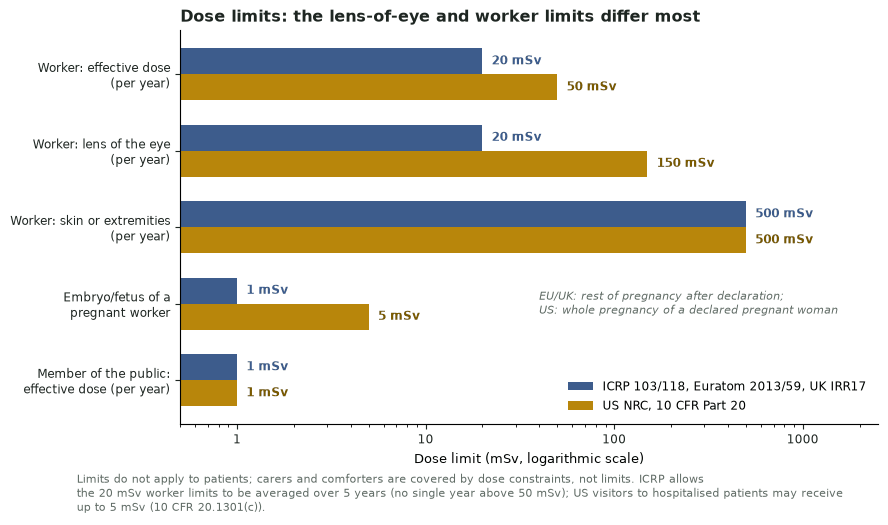
- Worker limits: 20 mSv/year effective (ICRP 103 allows 100 mSv over 5 years, ≤50 in any year), lens 20 mSv (ICRP 118; Euratom; IRR17), skin and extremities 500 mSv. US (10 CFR 20.1201): 50 mSv effective, lens 150 mSv, skin and extremities 500 mSv.
- Public: 1 mSv/year. UK: 5 mSv over 5 years for people (other than carers) exposed through another person's medical exposure. US: visitors to hospitalised patients up to 5 mSv if the authorised user agrees.
- Carers and comforters: dose constraints, not limits. ICRP 94: a few mSv per episode; young children and casual visitors count as the public. EC RP 97: 3 mSv (adults to 60), 15 mSv (over 60), 1 mSv (children, unborn child). Ireland (HIQA 2020): 3 and 15 mSv per event, 0.3 mSv for a pregnant carer.
- US release (10 CFR 35.75; RG 8.39): release if dose to another person is unlikely to exceed 5 mSv; written instructions if it may exceed 1 mSv. ¹³¹I: release at ≤1.2 GBq, or ≤0.07 mSv/h at 1 m; instructions above 0.24 GBq or 0.02 mSv/h.
- European ¹³¹I discharge examples: Germany ≤3.5 µSv/h at 2 m (about 250 MBq retained); France 20 µSv/h and Italy 30 µSv/h at 1 m. Germany, ¹⁷⁷Lu-PSMA: 4.3 µSv/h at 2 m (about 2,300 MBq) for one cycle a year.
- US decay-in-storage (10 CFR 35.92): half-life ≤120 days; dispose of as ordinary waste only when an unshielded survey on the most sensitive scale reads background; deface labels.
- Transport (IAEA SSR-6; 49 CFR): TI = maximum mSv/h at 1 m × 100. Labels: I-WHITE (surface ≤0.005 mSv/h, TI 0), II-YELLOW (≤0.5 mSv/h, TI ≤1), III-YELLOW (≤2 mSv/h, TI ≤10). Type A limit (A2): ⁹⁹ᵐTc 4 TBq, ¹⁸F 0.6 TBq, ¹³¹I and ¹⁷⁷Lu 0.7 TBq.
Where the US ¹³¹I release activity comes from
Given. RG 8.39 Equation B-1 to total decay: D = 34.6 Γ Q₀ Tₚ E / r². For ¹³¹I, Γ = 2.2 R·cm²/(mCi·h) and Tₚ = 8.04 d. Occupancy factor E = 0.25 at r = 100 cm. The dose limit is 0.5 rem (5 mSv).
- Rearrange for activity: Q₀ = D r² / (34.6 Γ Tₚ E).
- Q₀ = 0.5 × 10,000 / (34.6 × 2.2 × 8.04 × 0.25) = 5,000 / 153 ≈ 33 mCi.
- Convert: 33 mCi × 37 MBq/mCi ≈ 1.2 GBq, the Table 1 value. The physical half-life and no tissue shielding make this conservative.
- A patient-specific model goes further: for 7.4 GBq after thyroidectomy, RG 8.39 obtains 4.5 mSv, so immediate release is possible with instructions and a recorded calculation.
Answer. About 1.2 GBq ¹³¹I meets the 5-mSv US criterion on conservative assumptions. Larger activities can be released on a documented patient-specific calculation.
How long must ¹³¹I waste be stored?
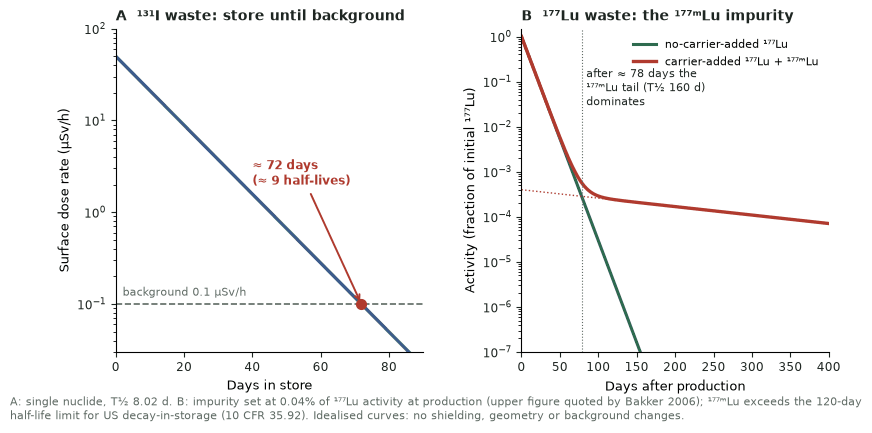
Given. A sealed bag of ¹³¹I-contaminated waste reads 50 µSv/h at the surface; background is 0.1 µSv/h; T½ = 8.02 d.
- Required reduction: 50 / 0.1 = 500 = 2ⁿ, so n = log₂ 500 ≈ 9.0 half-lives.
- Time = 9.0 × 8.02 d ≈ 72 days; then survey, deface the labels and dispose of the bag.
- Contrast carrier-added ¹⁷⁷Lu: if ¹⁷⁷ᵐLu (T½ 160.4 d) was 0.04% of the activity at production, it dominates after about 78 days. A further 1,000-fold fall needs 10 half-lives, about 4.4 years.
Answer. About 10 weeks for ¹³¹I. Carrier-added ¹⁷⁷Lu waste can need years, and ¹⁷⁷ᵐLu exceeds the US 120-day decay-in-storage limit.
The framework
- ICRP 103: justification, optimisation (ALARA) and dose limitation. Limits apply to workers and the public, never to patients. IAEA GSR Part 3 (2014) makes these the international Basic Safety Standards; Euratom 2013/59 binds EU states and requires dose constraints for carers and comforters.
- UK: IRR17 protects workers and the public (HSE; radiation protection adviser). IR(ME)R 2017 covers patients and carers, and requires employer and practitioner licences, advised by ARSAC, for administering radioactive substances. Environmental permits control holding and disposal.
- US: the NRC licenses use under 10 CFR Part 20 (protection standards) and Part 35 (medical use), with an RSO and authorised users; Agreement States run compatible programmes; the Department of Transportation regulates transport.
Releasing patients after therapy
- US: release on administered activity (RG 8.39 Table 1), measured dose rate at 1 m, or a patient-specific calculation. A record is needed when release relies on retained activity, dose rate, occupancy below 0.25 or effective half-life.
- ¹⁷⁷Lu is not in Table 1, so US centres calculate or measure. After 7.4 GBq ¹⁷⁷Lu-DOTATATE the dose rate at 1 m was 7.5 ± 3.6 µSv/h, and patients can usually leave the next day.
- Europe and the UK: national discharge criteria derive from the public limit and carer constraints. ICRP 94 advises an individual decision, because admission has psychological and financial costs, and notes that journeys of a few hours rarely endanger other passengers.
- Before treatment, ask about home, travel, household (children, pregnancy), toilet facilities and ability to comply (RG 8.39 Rev. 1). Discourage public transport, and give documents for radiation detectors at borders and airports, which can detect ¹³¹I patients for weeks.
- Written instructions for the first days: keep a prudent distance, sleep alone, avoid public transport and long journeys with others, use a separate toilet if possible, drink plenty, avoid close contact with children and pregnant women, and call a named contact number with questions.
Radioactive waste
- Segregate by radionuclide and half-life; store shielded, labelled and secure until a survey reads background. ⁹⁹ᵐTc and ¹⁸F need only days.
- ¹⁷⁷Lu: carrier-added product (made from ¹⁷⁶Lu) contains ¹⁷⁷ᵐLu, specified at up to 0.4 kBq per MBq at the end of irradiation. One centre stores used vials for 5 years and other waste for 3. No-carrier-added ¹⁷⁷Lu (from ¹⁷⁶Yb) avoids this.
- Excreta are exempt from US sewer limits (10 CFR 20.2003); some European countries use delay tanks. ICRP 94 found little benefit from storing urine.
Transport
- IAEA SSR-6 (2018 edition; a 2025 edition, Rev. 2, followed) is adopted into modal rules such as ADR in Europe and 49 CFR in the US. Package types: excepted, industrial, Type A (contents within A1/A2), Type B(U)/B(M) and Type C.
- Most radiopharmaceutical consignments are excepted or Type A. The excepted limit for liquids is 10⁻⁴ A2 (0.4 GBq ⁹⁹ᵐTc) with a surface dose rate ≤5 µSv/h, so a 740 MBq ⁹⁹ᵐTc syringe travels as Type A.
- Transport rules exclude radioactive material incorporated in a person for diagnosis or treatment. Staff who prepare or carry packages need hazardous-materials training.
Incidents and reporting
- US medical event (10 CFR 35.3045): dose differs from the prescription by more than 0.05 Sv effective, 0.5 Sv to an organ or 0.5 Sv to the skin, and the dosage is 20% or more off; or wrong drug, route, patient or mode above 0.05 Sv. Notify the NRC by the next calendar day, report in writing within 15 days, and tell the patient and referrer within 24 h.
- A US written directive is required before ¹³¹I-iodide above 1.11 MBq (30 µCi) or any therapeutic dosage (35.40); a dose above 50 mSv to an embryo, fetus or nursing child is reportable (35.3047).
- UK: significant accidental or unintended exposures (IR(ME)R regulation 8) are notified to the CQC (England), HIW, HIS or RQIA within about 2 weeks, with a report within 12 weeks. 2020 criteria include therapy activity outside ±10% (SIRT ±20%), a fetal dose ≥1 mGy after a failed pregnancy enquiry, and an infant dose ≥1 mSv after a breastfeeding procedure failure.
- Worker or public over-exposures go to the HSE (IRR17 regulation 26). Every incident and near miss is investigated and recorded locally.
In depth
- RG 8.39 Table 1 assumes an occupancy factor of 0.25 at 1 m for half-lives over 1 day but 1.0 for half-lives of 1 day or less, because short-lived nuclides deliver most of their dose in the first hours. Patient-specific calculations may use 0.125 if the patient lives alone for 2 days.
- Internal dose to contacts is minor: assuming intake of 10⁻⁵ of the activity, RG 8.39 obtains 0.17 mSv for 1.1 GBq ¹³¹I, about 3% of the external dose; below 10% it may be ignored.
- UK 2020 criteria for unintended diagnostic exposures are graded by intended dose: below 0.3 mSv, notify at ≥3 mSv (adult) or ≥1 mSv (child); 0.3–2.5 mSv, at ≥10 times intended; 2.5–10 mSv, at ≥25 mSv; above 10 mSv, at ≥2.5 times.
- Germany also applies activity limits for unrestricted disposal (1 MBq and 10 Bq/g for ¹³¹I); dialysate from haemodialysis patients can exceed them for weeks after the patient meets discharge criteria.
- In one French series, ¹⁷⁷ᵐLu was about 0.3% of residual vial activity at measurement (fitted half-life about 152 days) and set the 3–5-year storage times.
- An NRC proposed rule (2024) would make extravasations needing medical attention for suspected radiation injury reportable; see administration & extravasation.
Sources: NRC RG 8.39 Rev. 1 (2020), App. B · UK IR(ME)R SAUE guidance v2 (2020) · Kupitz 2025 (PMID 41134547) · Prevot 2023 (PMID 36622501) · Bakker 2006 (PMID 17043624) · ICRP 94 (PMID 15571759)
Sources
- International Commission on Radiological Protection. The 2007 recommendations of the International Commission on Radiological Protection. ICRP Publication 103. Ann ICRP. 2007;37(2–4).
- International Commission on Radiological Protection. Release of patients after therapy with unsealed radionuclides. ICRP Publication 94. Ann ICRP. 2004;34(2).
- Council of the European Union. Council Directive 2013/59/Euratom laying down basic safety standards for protection against the dangers arising from exposure to ionising radiation. Official Journal of the European Union. 2014;L13:1–73.
- European Commission. Radiation protection following iodine-131 therapy (exposures due to out-patients or discharged in-patients). Radiation Protection 97. 1998.
- Health and Safety Executive. Work with ionising radiation. Ionising Radiations Regulations 2017. Approved Code of Practice and guidance (L121). HSE; 2018.
- US Nuclear Regulatory Commission. Release of patients administered radioactive material. Regulatory Guide 8.39, Revision 1. 2020.
- International Atomic Energy Agency. Regulations for the safe transport of radioactive material, 2018 edition. Specific Safety Requirements SSR-6 (Rev. 1). IAEA; 2018.
- Care Quality Commission, Healthcare Inspectorate Wales, Healthcare Improvement Scotland, RQIA. Significant accidental and unintended exposures under IR(ME)R: guidance for employers and duty-holders, version 2. 2020.
- Kupitz D, Wissel H, Volk M, Kreissl MC, Grosser OS. Hemodialysis-associated radioactive waste management in [¹³¹I]I and [¹⁷⁷Lu]Lu radionuclide therapy. J Appl Clin Med Phys. 2025;26:e70314.
- Prevot S, Dygaï-Cochet I, Riedinger JM, et al. Dealing with dry waste disposal issues associated with ¹⁷⁷ᵐLu impurities: a long-term challenge for nuclear medicine departments. EJNMMI Phys. 2023;10:3.