Radiopharmacy Practice & Adverse Reactions
Radiopharmaceuticals are prepared under aseptic conditions with ALARA radiation protection — shielded vials and syringes, dose calibrators and careful record-keeping. True adverse reactions to diagnostic agents are rare (about 1–11 per 100,000 administrations in published surveys) and mostly mild; a far more frequent practical problem is extravasation of the injected dose.
Good radiopharmacy practice (cGRPP) combines pharmaceutical sterility with radiation safety: laminar-flow hoods, lead shielding, contamination monitoring, and traceable documentation from generator to patient.
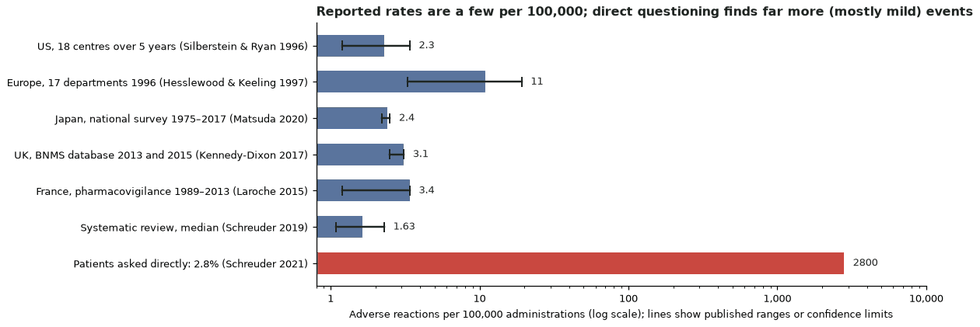
- US prospective survey: 2.3 adverse reactions per 100,000 administrations; none needed hospital admission.
- Europe (17 departments, 1996): 11 per 100,000; Japan (1975–2017): 2.4 per 100,000; UK BNMS database: 2.5–3.1 per 100,000.
- Toxicity comes from the pharmaceutical part (ligand, albumin, excipients), not from the trace amount of radionuclide.
- Common reactions: rash, itching, nausea and vomiting, flushing, vasovagal symptoms; bronchospasm and hypotension are rare.
- Intramuscular adrenaline is first-line for anaphylaxis; antihistamines are not.
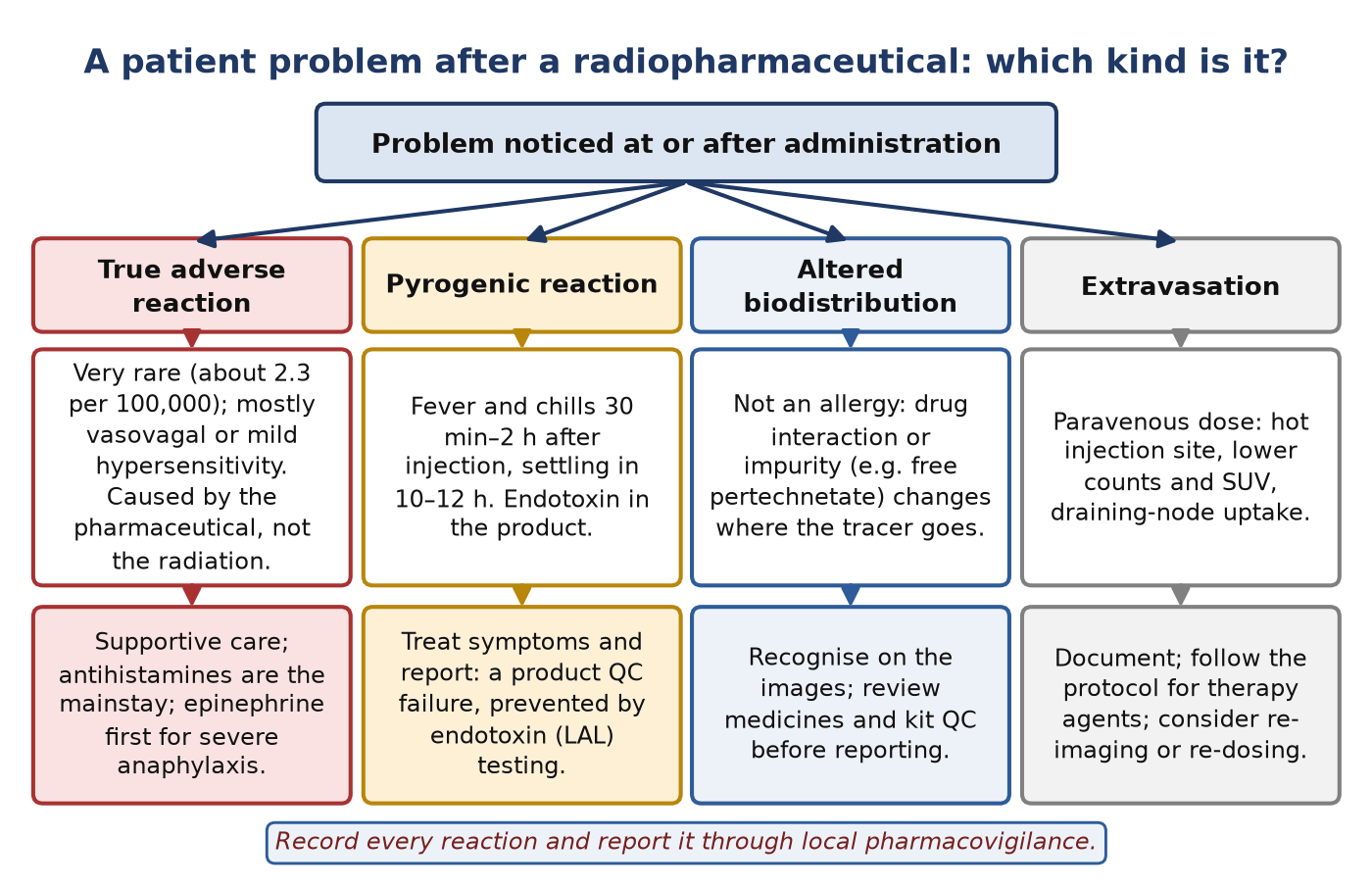
- Pyrogenic reactions appear 30 min–2 h after injection and settle within about 10–12 h.
- In-vivo ⁹⁹ᵐTc-RBC labelling is impaired by heparin, dextran, doxorubicin, penicillin and hydralazine.
- Voluntary reporting under-counts: patients report reactions far more often than surveys record.
Expected adverse reactions for a busy department
Given. 43,000 administrations/yr; incidence 2.3 per 100,000.
- Rate = 2.3×10⁻⁵ per administration
- 43,000 × 2.3×10⁻⁵ = 0.99
Answer. ≈ 1 reported reaction per year — reactions are rare and usually mild.
Safe preparation & handling
- Aseptic manipulations (generator elution, kit reconstitution, dispensing) take place in a grade A laminar-flow cabinet or isolator, in a grade C (cabinet) or grade D (isolator) background.
- Syringe and vial shields, tongs and distance limit finger and whole-body dose; lead shielding surfaces are covered to avoid lead dust.
- Every dose is measured in a dose calibrator and labelled with product, activity and reference time; records give traceability from generator or batch to patient.
- Blood-cell labelling uses a dedicated laminar-flow cabinet, and two patients' cells are never handled at the same time.
Adverse reactions
- Genuine reactions are uncommon; vasovagal reactions, rash, itching, nausea and mild hypersensitivity predominate.
- Serious reactions are very rare with diagnostic agents; reported deaths have been almost all with therapeutic agents.
- ⁹⁹ᵐTc-MAA: use a reduced particle number in right-to-left shunt and pulmonary hypertension.
- Anaphylaxis is treated with intramuscular adrenaline first (adult 0.5 mg, 0.5 mL of 1 mg/mL), airway support and fluids; antihistamines are adjuncts for skin symptoms only.
Reporting
- EU/UK: report suspected adverse reactions to the national competent authority (UK: MHRA Yellow Card); in the UK, radiopharmaceutical events and product defects can also be logged with the BNMS database.
- US: report to the FDA through MedWatch; misadministrations of licensed material also fall under NRC or Agreement State rules.
- Record the product, batch, activity, time course and outcome; biodistribution changes caused by drugs are recorded but are not allergic reactions.
Extravasation
- Inspect the injection site; a paravenous dose lowers image counts and SUV and can mimic nodal uptake.
- Diagnostic ⁹⁹ᵐTc, ¹²³I, ¹⁸F and ⁶⁸Ga extravasations need no specific treatment beyond documentation and, if needed, repeat imaging.
- For therapeutic agents, act promptly: elevate and massage or warm the limb to disperse activity, image to quantify, estimate the local absorbed dose and follow up the skin.
Pitfalls
- Inadequate shielding raises staff extremity dose.
- Poor documentation breaks traceability.
- Handling therapy isotopes (¹³¹I volatility) needs extra containment.
In the clinic — why the physics matters
- Because reactions stem from the pharmaceutical, a patient with albumin hypersensitivity is at risk from ⁹⁹ᵐTc-MAA.
- Altered biodistribution from drug interactions is commoner than true allergy and causes misread scans (e.g. dipyridamole increases and propranolol decreases ²⁰¹Tl myocardial uptake).
- Iodide-containing drugs and iodinated contrast block thyroid uptake of ¹²³I/¹³¹I, invalidating uptake studies.
- Pyrogenic reactions are prevented by endotoxin testing — a quality-control fix, not a patient treatment.
Reported reactions by radiopharmaceutical (Saha / Silberstein)
| Radiopharmaceutical | Reported reactions |
|---|---|
| ⁹⁹ᵐTc-pertechnetate | nausea, pruritus, headache, hives, chills |
| ⁹⁹ᵐTc-sulfur colloid | hypotension, dyspnea, chills, nausea, fever, dizziness |
| ⁹⁹ᵐTc-MAA | hypersensitivity to albumin |
| ⁹⁹ᵐTc-sestamibi | headache, chest pain, nausea, metallic taste |
| ²⁰¹Tl-chloride | fever, rash, pruritus, dyspnea, sweating |
| ¹⁸F-FDG | flushing of face and trunk |
Common pitfalls & misconceptions
- The radioactivity does not cause the reaction — the pharmaceutical or kit component does.
- Altered biodistribution (a drug interaction) is not an allergic reaction.
- Do not overstate the danger of diagnostic agents — rates are a few per 100,000 and mostly mild; serious events and deaths have been reported mainly with therapeutic agents.
- A pyrogenic reaction is not an allergy — it is endotoxin-driven fever and chills, 30 min–2 h after injection.
In depth
- Silberstein and Ryan (US, 18 institutions, 5 years): 18 reactions in 783,525 radiopharmaceutical administrations (2.3 per 100,000, 95% CI 1.2–3.4); 10 of the 18 were rashes and none required hospital admission. They also published a causality algorithm used by later surveys.
- The European prospective survey (17 departments, 1996) found 11 events per 100,000 (95% CI 3.3–19.2), none serious; the higher figure partly reflects the inclusion of vasovagal events.
- Japan's national survey (1975–2017) recorded 1,099 reactions in 46.6 million administrations (2.4 per 100,000): vasovagal 50%, allergic 26%, fever 7.5%; 3.7% were severe and none fatal. The rate fell from 3.7 to 1.5 per 100,000 after 1997; recent annual surveys report 1–2 per 100,000.
- French pharmacovigilance (1989–2013): 304 reports, 43% classed as serious, and 12 deaths — 9 with therapeutic agents, mainly pulmonary reactions to ¹³¹I-lipiodol. Reported diagnostic reactions ran at 1.2–3.4 per 100,000 administrations.
- UK BNMS database (2007–2016): 204 reports, most for diagnostic agents; the commonest were rash, itching and vomiting, and tetrofosmin and oxidronate were the most often reported products.
- Under-reporting is large: a systematic review found a median of 1.6 per 100,000 in published data, but when 1,002 patients were asked directly, 2.8% reported a reaction judged possibly or probably related — mostly mild and resolving within hours.
- A systematic review of extravasation found 3,016 reported diagnostic extravasations with symptoms in only 3, and 10 therapeutic extravasations, the worst causing ulceration; for therapeutic agents it advises dispersal, dosimetry and follow-up, with surgery considered in severe cases.
- For ¹⁷⁷Lu extravasations, reported tissue doses of 6–10 Gy were below the 20 Gy threshold for ulceration; EANM advises SPECT to measure the infiltrated volume and imaging at about 2, 4 and 24 h to build the time–activity curve.
Sources: Silberstein & Ryan 1996 (PMID 8543992) · Hesslewood & Keeling 1997 (PMID 9283115) · Matsuda et al. 2020 (PMID 31989466) · Laroche et al. 2015 (PMID 25366341) · Kennedy-Dixon et al. 2017 (PMID 28522742) · Schreuder et al. 2019 (PMID 31470933); 2021 (PMID 33094442) · van der Pol et al. 2017 (PMID 28303300) · EANM dosimetry committee 2022 (PMID 35284969)
Sources
- Silberstein EB, Ryan J. Prevalence of adverse reactions in nuclear medicine. J Nucl Med. 1996;37:185–92.
- Hesslewood SR, Keeling DH. Frequency of adverse reactions to radiopharmaceuticals in Europe. Eur J Nucl Med. 1997;24:1179–82.
- Matsuda H, Uehara T, Okazawa H, et al. Full report on a survey of adverse reactions to radiopharmaceuticals from 1975 to 2017 in Japan. Ann Nucl Med. 2020;34:299–304.
- Laroche ML, Quelven I, Mazère J, Merle L. Adverse reactions to radiopharmaceuticals in France: analysis of the national pharmacovigilance database. Ann Pharmacother. 2015;49:39–47.
- Kennedy-Dixon TG, Gossell-Williams M, Cooper M, et al. Evaluation of radiopharmaceutical adverse reaction reports to the British Nuclear Medicine Society from 2007 to 2016. J Nucl Med. 2017;58:2010–2.
- Schreuder N, Koopman D, Jager PL, et al. Adverse events of diagnostic radiopharmaceuticals: a systematic review. Semin Nucl Med. 2019;49:382–410.
- Schreuder N, Jacobs NA, Jager PL, et al. Patient-reported adverse events of radiopharmaceuticals: a prospective study of 1002 patients. Drug Saf. 2021;44:211–22.
- van der Pol J, Vöö S, Bucerius J, Mottaghy FM. Consequences of radiopharmaceutical extravasation and therapeutic interventions: a systematic review. Eur J Nucl Med Mol Imaging. 2017;44:1234–43.
- Gillings N, Hjelstuen O, Ballinger J, et al. Guideline on current good radiopharmacy practice (cGRPP) for the small-scale preparation of radiopharmaceuticals. EJNMMI Radiopharm Chem. 2021;6:8.
- Resuscitation Council UK. Emergency treatment of anaphylaxis: guidelines for healthcare providers. London: RCUK; 2021.