⁹⁹Mo/⁹⁹ᵐTc Generator
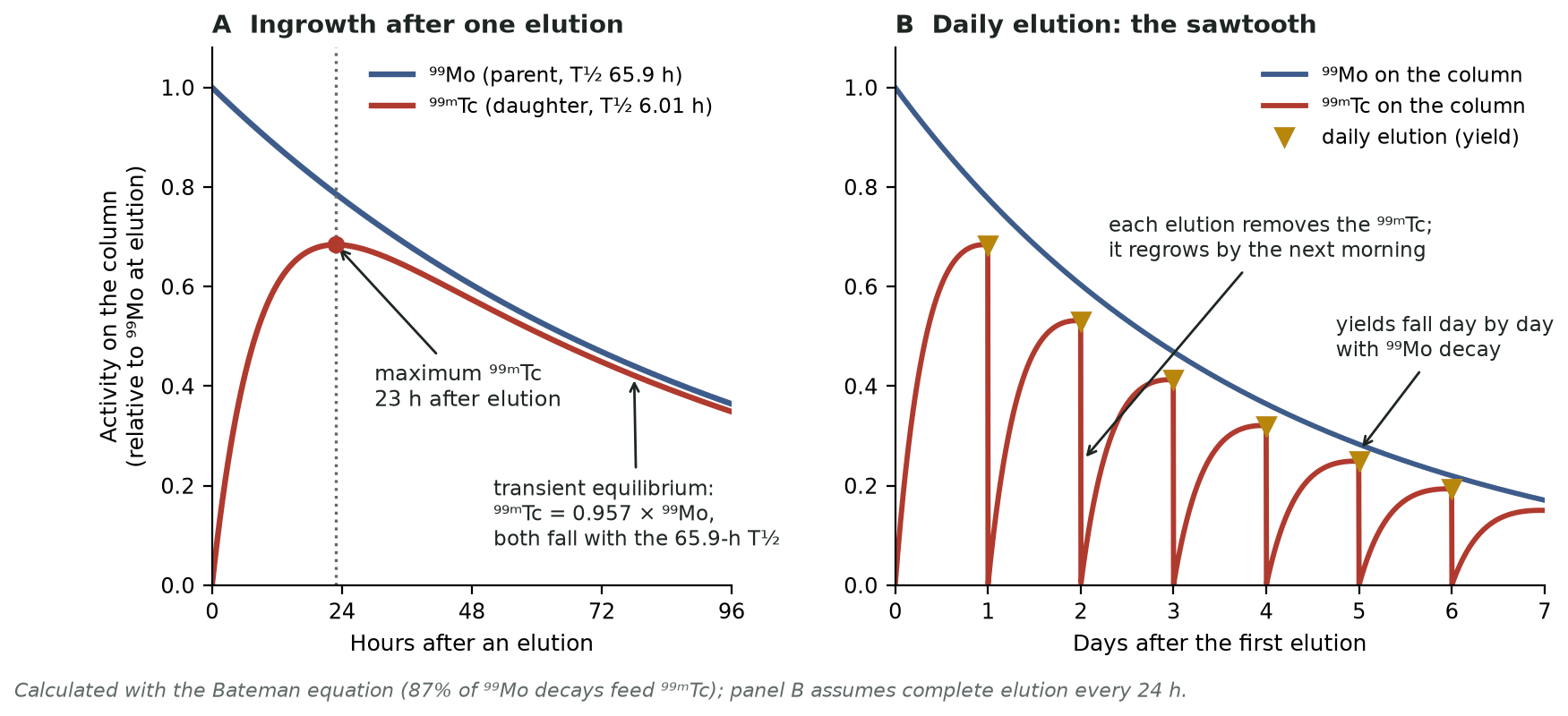
The ⁹⁹Mo/⁹⁹ᵐTc generator brings ⁹⁹ᵐTc to every department. ⁹⁹Mo (half-life ~66 h) is adsorbed on an alumina column and decays to ⁹⁹ᵐTc (6 h), which is eluted with sterile saline as sodium pertechnetate. Because it is a transient equilibrium, ⁹⁹ᵐTc regrows after each elution, allowing repeated daily elutions.
Pertechnetate (⁹⁹ᵐTcO₄⁻) is washed off the column while ⁹⁹Mo remains bound. Yield is highest ~24 h after the previous elution (equilibrium). Purity checks guard against parent and column breakthrough.
- ⁹⁹Mo: T½ 66 h, β⁻; about 87% of decays feed ⁹⁹ᵐTc and 13% go directly to ground-state ⁹⁹Tc; γ-rays at 181, 740 and 778 keV.
- ⁹⁹ᵐTc: T½ 6.01 h, isomeric transition, 140-keV γ in about 89% of decays (the rest mainly internal conversion).
- The column holds 5–10 g of alumina; ⁹⁹ᵐTc is eluted as Na⁹⁹ᵐTcO₄ in 0.9% saline.
- ⁹⁹ᵐTc peaks about 23 h after an elution (t_max = ln(λ_Tc/λ_Mo)/(λ_Tc − λ_Mo)); thereafter A_Tc ≈ 0.96 × A_Mo.
- ⁹⁹Mo breakthrough limit (USP/NRC): 0.15 µCi ⁹⁹Mo per mCi ⁹⁹ᵐTc at administration; Ph. Eur. 0.1% of total activity.
- Aluminium: ≤10 µg/mL (USP) or ≤5 µg/mL (Ph. Eur.); eluate pH 4.5–7.5 (USP).
- Practical elution yield is 80–90%; a typical label sets eluate expiry at 12 h.
- About 24 h after an elution only about 28% of the technetium atoms in the eluate are ⁹⁹ᵐTc; the rest are ⁹⁹Tc.
Ingrowth and elution yield after 24 h
Given. A generator holds 20 GBq ⁹⁹Mo at a complete elution at 08:00 (T½ ⁹⁹Mo 65.9 h, ⁹⁹ᵐTc 6.01 h, 87% branching, elution efficiency 85%). What can be eluted at 08:00 next day, and when is ⁹⁹ᵐTc maximal?
- λ_Mo = 0.693/65.9 = 0.01052 h⁻¹; λ_Tc = 0.693/6.01 = 0.1153 h⁻¹.
- Equilibrium factor K = 0.87 × λ_Tc/(λ_Tc − λ_Mo) = 0.87 × 0.1153/0.1048 = 0.957.
- A_Tc(24 h) = K × 20 × (e^(−0.01052×24) − e^(−0.1153×24)) = 0.957 × 20 × (0.777 − 0.063) = 13.7 GBq on the column.
- Eluted = 13.7 × 0.85 = 11.6 GBq.
- t_max = ln(0.1153/0.01052)/(0.1153 − 0.01052) = 2.395/0.1048 = 22.9 h.
Answer. About 11.6 GBq can be eluted at 24 h; the column content peaks at about 23 h, so daily elution gives near-maximal yield.
⁹⁹Mo breakthrough at the time of administration
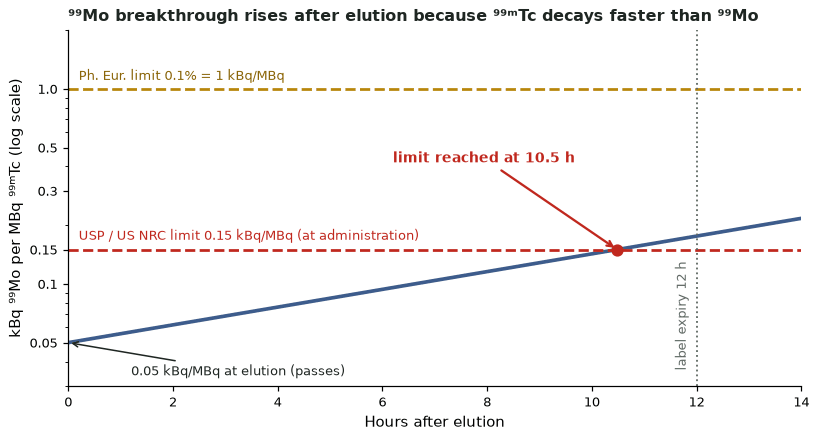
Given. At 08:00 an eluate contains 30 GBq ⁹⁹ᵐTc and 1.5 MBq ⁹⁹Mo. The USP/NRC limit is 0.15 kBq ⁹⁹Mo per MBq ⁹⁹ᵐTc at administration. Until when can doses from it be given?
- Ratio at elution = 1.5 MBq / 30,000 MBq = 5×10⁻⁵ = 0.05 kBq/MBq — passes.
- ⁹⁹ᵐTc decays faster than ⁹⁹Mo, so the ratio grows as e^((λ_Tc − λ_Mo)t) = e^(0.1048t).
- Limit reached when e^(0.1048t) = 0.15/0.05 = 3 → t = ln3/0.1048 = 10.5 h.
- By comparison the Ph. Eur. limit (0.1% = 1 kBq/MBq) would need a factor of 20: t = ln20/0.1048 = 28.6 h.
Answer. Doses from this eluate meet the USP/NRC limit only until about 18:30 (10.5 h), earlier than the 12-h label expiry.
How it works
- ⁹⁹Mo adsorbed as molybdate on an alumina (Al₂O₃) column decays to ⁹⁹ᵐTc; saline elutes sodium pertechnetate (⁹⁹ᵐTcO₄⁻) while molybdate stays bound.
- Transient equilibrium: after an elution the daughter activity grows, peaks about 23 h later and then decays with the 66-h parent half-life.
- The eluate is sterile, pyrogen-free sodium pertechnetate with technetium in the +7 oxidation state; generator elution is itself an aseptic manipulation.
Quality of the eluate
- ⁹⁹Mo breakthrough — USP and US NRC: ≤0.15 kBq ⁹⁹Mo per MBq ⁹⁹ᵐTc (0.15 µCi/mCi) at the time of administration, measured on every eluate. Ph. Eur. (EU/UK): ≤0.1% of total radioactivity (1 kBq/MBq).
- Alumina breakthrough is checked colorimetrically: Al³⁺ ≤10 µg/mL (USP) or ≤5 µg/mL (Ph. Eur.).
- The radiochemical form must be pertechnetate (Ph. Eur. ≥95% of radioactivity); pH 4.5–7.5 (USP) or 4.0–8.0 (Ph. Eur.).
Pitfalls
- Excess ⁹⁹Mo breakthrough gives unnecessary patient dose from the 740/778-keV photons and β⁻ particles, and degrades images.
- Long intervals between elutions raise ⁹⁹Tc carrier in the eluate; for this reason exametazime (HMPAO) needs eluate no more than 2 h old from a generator eluted within the previous 24 h.
- Alumina in the eluate impairs labelling (for example flocculation of sulfur colloid).
In the clinic — why the physics matters
- Elute regularly (daily) to maximise yield and minimise ⁹⁹Tc carrier — ⁹⁹Tc competes with ⁹⁹ᵐTc for stannous reduction and can lower labelling efficiency.
- ⁹⁹Mo breakthrough is checked on every eluate: the eluate is assayed in a lead pot that stops the 140-keV photons but passes the 740/778-keV ⁹⁹Mo photons.
- Excess aluminium flocculates ⁹⁹ᵐTc-sulfur colloid (lung uptake) and agglutinates labelled red cells — hence the aluminium limit.
- ⁹⁹ᵐTc-exametazime (HMPAO) needs eluate no more than 2 h old from a generator eluted within the previous 24 h.
Pertechnetate eluate specifications: USP (US) and Ph. Eur. (EU/UK)
| Test | USP / US NRC | Ph. Eur. (fission ⁹⁹Mo) |
|---|---|---|
| ⁹⁹Mo | ≤0.15 kBq/MBq (0.015%) at administration; every eluate | ≤0.1% of total radioactivity |
| ¹³¹I | ≤0.05 µCi/mCi | ≤5×10⁻³ % (numerically the same) |
| ¹⁰³Ru, ⁸⁹Sr, ⁹⁰Sr | see monograph | 5×10⁻³ %, 6×10⁻⁵ %, 6×10⁻⁶ % |
| α emitters | ≤0.001 nCi/mCi | ≤1×10⁻⁷ % (numerically the same) |
| Aluminium | ≤10 µg/mL | ≤5 µg/mL |
| pH | 4.5–7.5 | 4.0–8.0 |
| Radiochemical purity | pertechnetate | ≥95% as pertechnetate |
| Eluate expiry | per label, typically 12 h | per SmPC |
Common pitfalls & misconceptions
- This is transient (not secular) equilibrium — half-lives differ ~11-fold, daughter tracks parent after ~24 h.
- The daughter never exceeds the parent here — only 87% of ⁹⁹Mo → ⁹⁹ᵐTc, so A_Tc = 0.957·A_Mo (slightly less).
- Only ~90% of ⁹⁹ᵐTc transitions give the 140-keV imaging photon.
- Eluate specific activity (fraction that is ⁹⁹ᵐTc) falls the longer since last elution.
In depth
- The time of peak daughter activity is t_max = ln(λ_d/λ_p)/(λ_d − λ_p): 22.9 h for ⁹⁹Mo/⁹⁹ᵐTc. The column already holds about 60% of that peak 6 h after an elution, which is why a second elution in the afternoon is worthwhile when demand is high.
- In transient equilibrium A_d/A_p = BR × T_p/(T_p − T_d); with an 87% branching ratio this gives 0.957, so the ⁹⁹ᵐTc activity stays slightly below the ⁹⁹Mo activity — the daughter never overtakes the parent in this generator.
- ⁹⁹Tc (T½ 2.1×10⁵ y) accumulates on the column from the 13% direct branch and from decay of ⁹⁹ᵐTc, so the ⁹⁹ᵐTc fraction of technetium atoms falls the longer the column stands (about 28% at 24 h). A first elution after a weekend therefore carries more ⁹⁹Tc carrier.
- Because ⁹⁹ᵐTc decays faster than ⁹⁹Mo, the ⁹⁹Mo/⁹⁹ᵐTc ratio grows by e^((λ_Tc − λ_Mo)t) — about 2.85-fold in 10 h — so the USP/NRC limit must be checked for the time of administration, not only at elution.
- The USP/NRC ⁹⁹Mo limit (0.015%) is about seven times stricter than Ph. Eur. (0.1%). The limits for ¹³¹I and α emitters are numerically identical in the two pharmacopoeias; aluminium (10 vs 5 µg/mL) and pH (4.5–7.5 vs 4.0–8.0) differ.
- US NRC 10 CFR 35.204 requires the licensee to measure the ⁹⁹Mo concentration in each eluate and to report any eluate that exceeds the limit; for ⁸²Sr/⁸²Rb generators ⁸²Sr (≤0.02 kBq/MBq) and ⁸⁵Sr (≤0.2 kBq/MBq) are measured before the first patient each day.
- The EANM cGRPP guideline classes generator elution, kit reconstitution and QC sampling as aseptic manipulations to be done in a grade A environment (grade C background for a laminar-flow cabinet, grade D for an isolator), with vial stoppers wiped with a sterile disinfectant that is allowed to evaporate before puncture.
Sources: Saha, Fundamentals of Nuclear Pharmacy, 7th ed. (2018), Ch. 5 · Cherry, Sorenson & Phelps, Physics in Nuclear Medicine, 4th ed. (2012) · TechneLite US prescribing information (2019) · Ph. Eur. monograph 0124 · 10 CFR 35.204 · Gillings et al. 2021 (PMID 33580358)
Sources
- Saha GB. Fundamentals of Nuclear Pharmacy. 7th ed. Cham: Springer; 2018.
- Cherry SR, Sorenson JA, Phelps ME. Physics in Nuclear Medicine. 4th ed. Philadelphia: Elsevier Saunders; 2012.
- Lantheus Medical Imaging. TechneLite (technetium Tc 99m generator) US prescribing information. 2019.
- European Pharmacopoeia. Sodium pertechnetate (⁹⁹ᵐTc) injection (fission), monograph 0124. Strasbourg: EDQM (current edition).
- US Nuclear Regulatory Commission. 10 CFR 35.204: Permissible molybdenum-99, strontium-82 and strontium-85 concentrations.
- Gillings N, Hjelstuen O, Ballinger J, et al. Guideline on current good radiopharmacy practice (cGRPP) for the small-scale preparation of radiopharmaceuticals. EJNMMI Radiopharm Chem. 2021;6:8.
Spotted an error or something out of date? Report an error