PET Radiopharmaceuticals
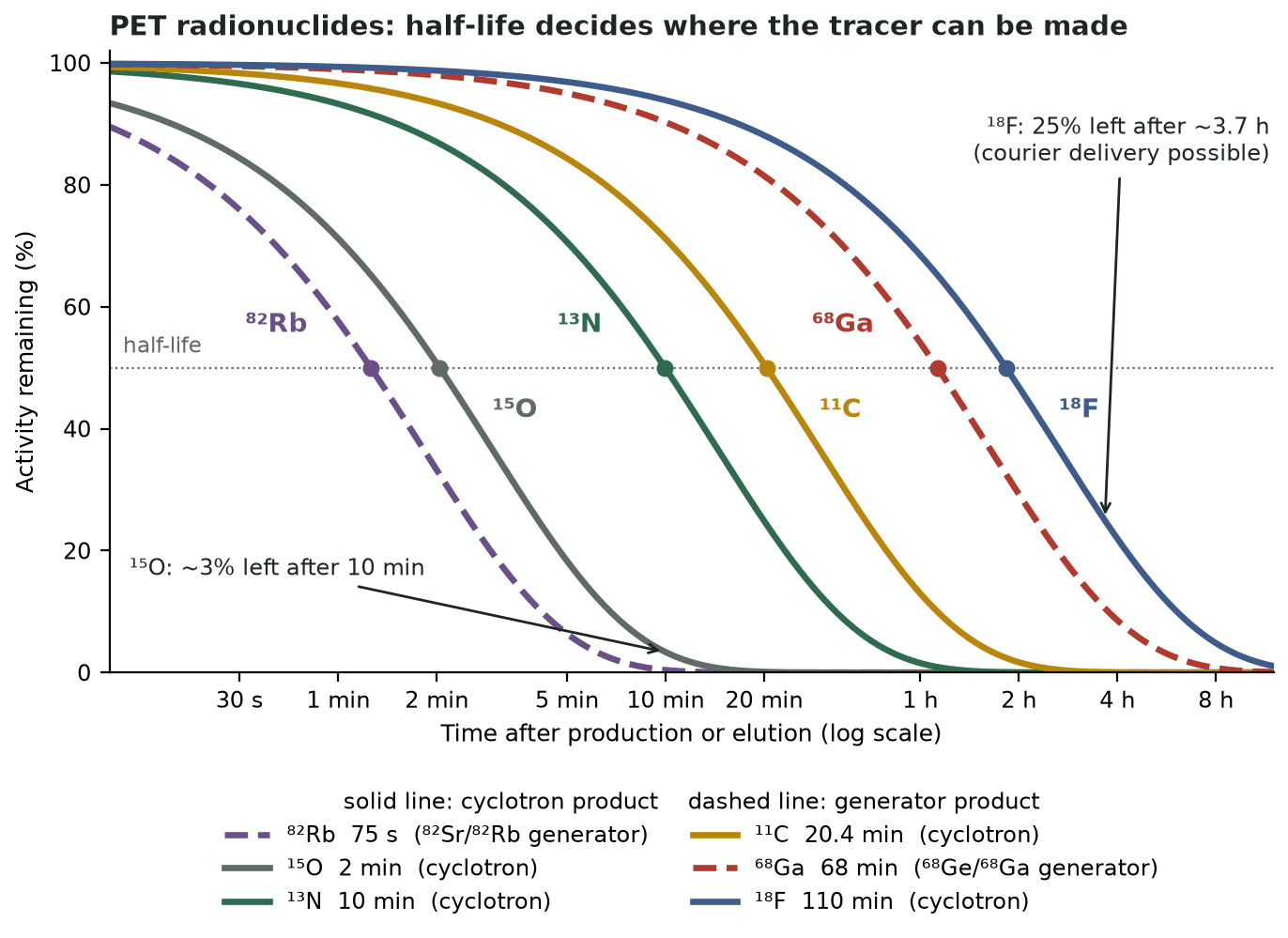
PET tracers are positron emitters, most short-lived and cyclotron-produced. ¹⁸F-FDG (¹⁸F half-life about 110 min) is made by nucleophilic ¹⁸F substitution and is the dominant agent; ⁶⁸Ga (68 min, from a ⁶⁸Ge/⁶⁸Ga generator) labels peptides (DOTATATE, PSMA); ⁸²Rb (75 s, from a ⁸²Sr/⁸²Rb generator) images myocardial perfusion; and ¹¹C (20 min) needs an on-site cyclotron.
The short half-lives demand efficient synthesis, rapid QC and tight logistics. Positron energy influences resolution (¹⁸F gives sharper images than ⁶⁸Ga).
- ¹⁸F: T½ 110 min, 97% β⁺ / 3% EC, made by ¹⁸O(p,n)¹⁸F on an [¹⁸O]water target.
- ⁶⁸Ga: T½ 68 min, from a ⁶⁸Ge/⁶⁸Ga generator (parent T½ 271 d) — on-site PET without a cyclotron.
- ¹¹C: T½ 20.4 min; ¹³N: 10 min; ¹⁵O: 2 min; ⁸²Rb: 75 s.
- ¹⁸F-FDG: nucleophilic substitution of mannose triflate by ¹⁸F⁻ activated with Kryptofix 2.2.2/K₂CO₃, then hydrolysis (base at room temperature, or acid with heating); yield >50% in about 50 min.
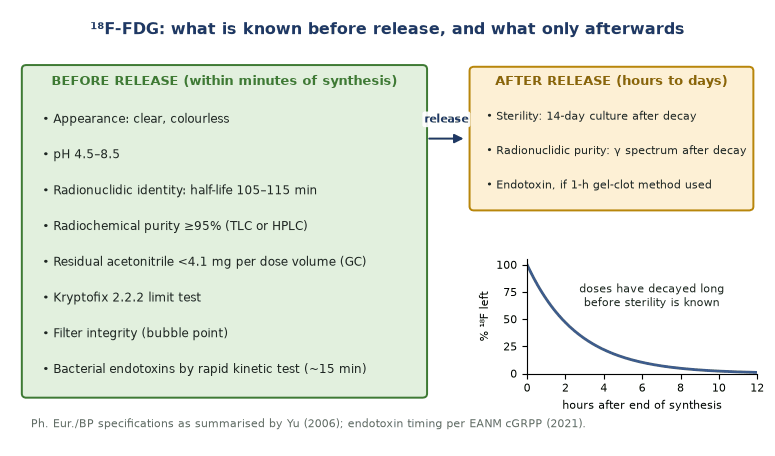
- FDG release (Ph. Eur./BP): half-life 105–115 min, pH 4.5–8.5, radiochemical purity ≥95%, acetonitrile <4.1 mg per maximum dose volume.
- ⁶⁸Ga-DOTATATE kit (NETSPOT): 95 °C for at least 7 min, radiochemical purity ≥95%, use within 4 h; ⁶⁸Ge breakthrough ≤0.001%.
- All positron emitters yield 511-keV annihilation photons.
- ¹³N-ammonia and ¹⁵O-water perfusion tracers must be made close to the scanner.
Decay of ¹⁵O-water over a 10-min delay
Given. ¹⁵O T½ = 2 min; 10-min delay before injection.
- n = 10/2 = 5 half-lives
- fraction = (½)⁵ = 1/32 = 3.1%
Answer. Only ~3% remains — why ¹⁵O and ⁸²Rb must be used within seconds–minutes at the scanner.
¹⁸F unit-dose reach
Given. ¹⁸F T½ 110 min.
- After 110 min: (½)¹ = 50% remains
- After ~3.7 h (2 half-lives): 25% remains
Answer. ¹⁸F's 110-min half-life permits centralised production and courier unit-dose delivery.
Key PET agents
- ¹⁸F-FDG: glucose analogue; whole-body oncology, cardiac viability, inflammation.
- ¹⁸F agents: NaF (bone), FDOPA, FES, PSMA-1007, flutemetamol (amyloid).
- ⁶⁸Ga: DOTATATE (NET) and PSMA (prostate) — generator-based, theranostic pairs.
- ⁸²Rb / ¹³N-ammonia: myocardial perfusion PET.
Production & synthesis
- FDG: cyclotron ¹⁸F⁻ + nucleophilic substitution then hydrolysis, in automated modules.
- ⁶⁸Ga eluted from the ⁶⁸Ge/⁶⁸Ga generator and complexed by a chelator on the peptide (DOTA for DOTATATE/DOTATOC; HBED-CC for PSMA-11).
- Short half-lives require same-day, often on-demand, production.
Pitfalls
- Logistics: ¹¹C/¹⁵O need an on-site cyclotron; ¹⁸F can be shipped a few hours.
- Radiolysis and incomplete synthesis lower radiochemical purity — QC each batch.
- Higher positron energy (⁶⁸Ga) slightly degrades spatial resolution.
In the clinic — why the physics matters
- ¹⁸F's 110-min half-life allows regional cyclotron production and courier delivery to PET centres without a cyclotron.
- The ⁶⁸Ge/⁶⁸Ga generator (271-d parent) lets non-cyclotron sites perform ⁶⁸Ga-DOTATATE and ⁶⁸Ga-PSMA PET.
- ¹³N, ¹⁵O and ⁸²Rb (10 min, 2 min, 75 s) must be produced or eluted at the scanner and given immediately.
- ⁶⁸Ga-DOTATATE (imaging) pairs with ¹⁷⁷Lu-DOTATATE (therapy) — a theranostic pair on the same target (see theranostics).
PET radionuclides
| Nuclide | T½ | Production | Example tracer / use |
|---|---|---|---|
| ¹⁸F | 110 min | ¹⁸O(p,n), cyclotron | FDG — glucose metabolism |
| ⁶⁸Ga | 68 min | ⁶⁸Ge/⁶⁸Ga generator | DOTATATE — neuroendocrine tumours |
| ¹¹C | 20.4 min | cyclotron | choline — recurrent prostate cancer |
| ¹³N | 10 min | ¹⁶O(p,α), cyclotron | ammonia — myocardial perfusion |
| ¹⁵O | 2 min | cyclotron | water — cerebral/myocardial perfusion |
| ⁸²Rb | 75 s | ⁸²Sr/⁸²Rb generator | chloride — myocardial perfusion |
Common pitfalls & misconceptions
- Not every PET tracer ships like FDG — ¹¹C/¹³N/¹⁵O/⁸²Rb decay too fast for transport.
- Production route ≠ decay mode — ¹⁸F is made by ¹⁸O(p,n) yet decays 97% β⁺.
- ⁶⁸Ga needs no cyclotron (generator); ¹⁸F/¹¹C/¹³N/¹⁵O are cyclotron-produced.
- Radiochemical yield ≠ radiochemical purity — FDG yield ~60% but purified product must still meet >95% RCP.
In depth
- FDG synthesis in a cassette module: [¹⁸F]fluoride is trapped on a quaternary-ammonium (QMA) cartridge so the [¹⁸O]water can be recovered, eluted with Kryptofix 2.2.2/K₂CO₃ in acetonitrile, dried azeotropically, reacted with mannose triflate (S_N2, inverting C-2 to the gluco configuration) and deprotected by hydrolysis; Hamacher (1986) achieved >50% yield in 50 min.
- Base hydrolysis (NaOH, room temperature, often on a C18 cartridge) has largely replaced acid hydrolysis (HCl, heated); 2-chloro-2-deoxyglucose is a by-product only of acid hydrolysis, which is why the pharmacopoeial test for it applies to that route.
- Kryptofix 2.2.2 is toxic (apnoea and convulsions), so modules include removal steps and the product is tested with a limit test (colour spot test on silica or gas chromatography).
- The original FDG synthesis (1976) was electrophilic, using [¹⁸F]F₂ from ²⁰Ne(d,α)¹⁸F with carrier fluorine: yield about 8% in 2 h, at most half of the ¹⁸F incorporated, and low specific activity.
- Because of the 110-min half-life, Ph. Eur./BP allow FDG to be released before sterility, bacterial-endotoxin and radionuclidic-purity results are complete; the membrane-filter integrity (bubble-point) test, required in US FDA PET guidance and recommended by EANM cGRPP, is the practical pre-release surrogate for sterility.
- EANM cGRPP for in-house PET products: synthesis in shielded hot cells of at least grade C (background at least grade D), sterile filtration and dispensing in grade A; kinetic chromogenic endotoxin tests take about 15 min (gel clot about 1 h) and should ideally be completed before release; for ¹³N-ammonia made in several batches a day, full testing of the first and last batch is acceptable after process validation.
- ⁸²Sr/⁸²Rb generators: the US NRC limits are ⁸²Sr ≤0.02 kBq and ⁸⁵Sr ≤0.2 kBq per MBq ⁸²Rb, measured before the first patient each day.
- PET radiopharmaceuticals have an excellent safety record: a US multicentre survey recorded no adverse reactions in 81,801 administrations.
Sources: Yu 2006 (PMID 21614337) · Hamacher et al. 1986 · NETSPOT US label (2023) · Gillings et al. 2021 (PMID 33580358) · 10 CFR 35.204 · Silberstein 1998 (PMID 9867168)
Sources
- Saha GB. Fundamentals of Nuclear Pharmacy. 7th ed. Cham: Springer; 2018.
- Hamacher K, Coenen HH, Stöcklin G. Efficient stereospecific synthesis of no-carrier-added 2-[¹⁸F]-fluoro-2-deoxy-D-glucose using aminopolyether supported nucleophilic substitution. J Nucl Med. 1986;27:235–8.
- Yu S. Review of ¹⁸F-FDG synthesis and quality control. Biomed Imaging Interv J. 2006;2:e57.
- Advanced Accelerator Applications. NETSPOT (kit for the preparation of gallium Ga 68 dotatate injection): US prescribing information. 2023.
- Gillings N, Hjelstuen O, Ballinger J, et al. Guideline on current good radiopharmacy practice (cGRPP) for the small-scale preparation of radiopharmaceuticals. EJNMMI Radiopharm Chem. 2021;6:8.
- Silberstein EB. Prevalence of adverse reactions to positron emitting radiopharmaceuticals in nuclear medicine. J Nucl Med. 1998;39:2190–2.
- US Nuclear Regulatory Commission. 10 CFR 35.204: Permissible molybdenum-99, strontium-82 and strontium-85 concentrations.