⁹⁹ᵐTc Radiochemistry & Cold Kits
Eluted pertechnetate (Tc⁷⁺) is unreactive, so a reducing agent — usually stannous chloride — reduces technetium so it can bind the ligand in a freeze-dried “cold kit”. Adding pertechnetate to the kit produces the labelled radiopharmaceutical (MDP, MAG3, sestamibi, DTPA, sulfur colloid, MAA, HMPAO). The two classic impurities are free pertechnetate and hydrolysed-reduced technetium.
Cold kits contain the ligand, stannous reductant and stabilisers, lyophilised and ready to reconstitute. Labelling efficiency (radiochemical purity) must be checked before use.
- ⁹⁹ᵐTc is used in about 80% of diagnostic nuclear-medicine procedures; T½ 6 h, 140-keV γ.
- Technetium (Z = 43) has oxidation states from −1 to +7; pertechnetate is +7 and +5 is common in ⁹⁹ᵐTc complexes.
- ⁹⁹ᵐTc in eluate is only about 10⁻⁹ M, so a trace of Sn²⁺ suffices — yet the Sn:Tc ratio in a kit may be about 10⁶.
- Stannous chloride (SnCl₂·2H₂O) is the usual reducing agent: 2TcO₄⁻ + 16H⁺ + 3Sn²⁺ → 2Tc⁴⁺ + 3Sn⁴⁺ + 8H₂O.
- Three species coexist after labelling: free ⁹⁹ᵐTcO₄⁻, hydrolysed-reduced ⁹⁹ᵐTcO₂ and the bound (desired) complex.
- Typical radiochemical-purity limits: MDP/DTPA >95%, MAA >90%, sestamibi ≥90%, exametazime (HMPAO) >80%.
- Unstabilised exametazime (used for leucocyte labelling) must be used within 30 min; the stabilised brain preparation within 4 h.
- Sestamibi needs 10 min in a boiling water bath; sulfur colloid 5 min in a boiling water bath.
MAA particles delivered in a lung-perfusion dose
Given. 20-mCi vial contains 2 million MAA particles; a 3-mCi dose is drawn.
- Particles scale with the activity fraction: 3/20 = 0.15
- Particles = 2,000,000 × 0.15
Answer. ≈ 300,000 particles — within the safe capillary-blockade range.
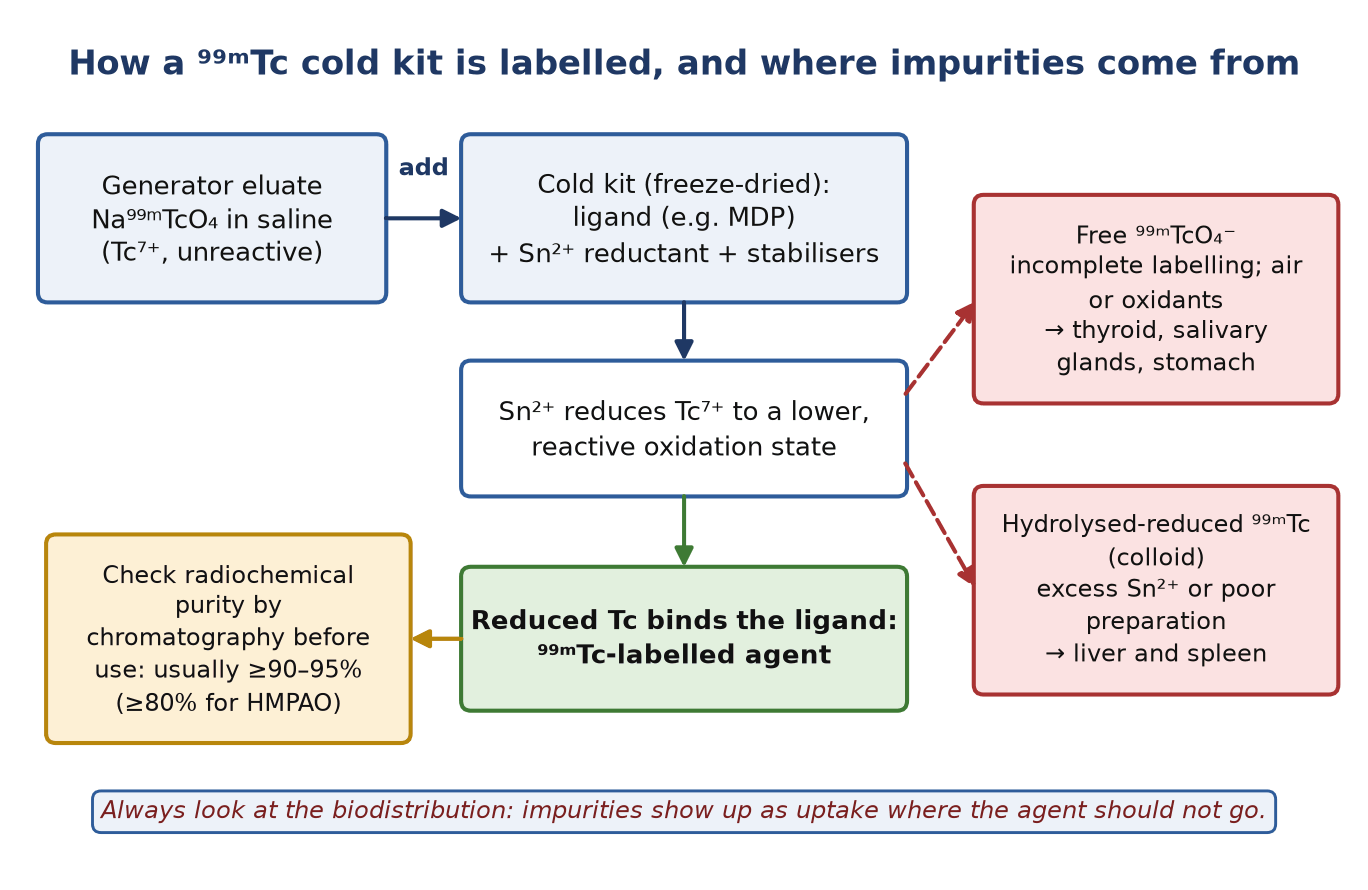
Labelling chemistry
- Stannous ion reduces Tc⁷⁺ to a reactive lower oxidation state that complexes the ligand.
- Kits are freeze-dried and reconstituted with pertechnetate; some need heating or incubation.
- Radiochemical purity (RCP) is confirmed by chromatography before administration (usually ≥90–95%; ≥80% for HMPAO).
Common ⁹⁹ᵐTc agents
- Bone: MDP/HDP (diphosphonates). Renal: MAG3 (tubular), DTPA (filtration).
- Cardiac: sestamibi/tetrofosmin. Lung: MAA (perfusion), Technegas/DTPA (ventilation).
- Liver/marrow: sulfur colloid. Brain: HMPAO, ECD; leucocyte labelling: HMPAO.
Impurities
- Free ⁹⁹ᵐTcO₄⁻ (incomplete labelling) → thyroid, salivary and gastric activity.
- Hydrolysed-reduced technetium (excess Sn²⁺/poor prep) → liver/spleen colloid uptake.
- Oxidation (air/oxidants) degrades labelling — minimise air, use promptly.
Pitfalls
- Aluminium breakthrough from the generator impairs labelling (e.g. sulfur-colloid aggregation).
- Expired or oxidised kits reduce RCP.
- Always inspect biodistribution for evidence of impurity.
In the clinic — why the physics matters
- Free ⁹⁹ᵐTcO₄⁻ behaves like pertechnetate — thyroid, salivary and gastric uptake add background — which is why kits contain excess Sn²⁺ and are sealed under nitrogen.
- Air oxidises Sn²⁺ to Sn⁴⁺, lowering the reducing capacity and raising free pertechnetate; hence antioxidants, nitrogen headspace and prompt use.
- Residual Sn²⁺ from a recent ⁹⁹ᵐTc kit (for example a bone scan) can label red cells in vivo, giving blood-pool activity on a later pertechnetate study.
- ⁹⁹ᵐTc-MAA: at least 90% of particles must be 10–90 µm (USP) or 10–100 µm (Ph. Eur.), with none larger than 150 µm, so that particles lodge in pre-capillary arterioles without blocking larger vessels.
Common ⁹⁹ᵐTc radiopharmaceuticals
| Agent | Chemistry / Tc state | RCP limit (typical) | Primary use |
|---|---|---|---|
| MDP / HDP | Sn²⁺ reduction; diphosphonate | >95% | Bone (chemisorption onto hydroxyapatite) |
| MAA | Sn²⁺; aggregated albumin 10–90 µm (USP) / 10–100 µm (Ph. Eur.) | >90% (particle-bound) | Lung perfusion (capillary blockade) |
| Sulfur colloid | acid + thiosulfate, boiling 5 min; Tc₂S₇ (Tc⁷⁺) | per label | Liver/spleen/marrow; lymphoscintigraphy |
| MAG3 | ligand exchange (heating); anionic complex | >90% | Renal tubular function |
| Exametazime (HMPAO) | lipophilic Tc⁵⁺ complex | >80% | Brain perfusion; leucocyte labelling |
| Sestamibi | Tc⁺ with six isonitriles; boiling 10 min | ≥90% | Myocardial perfusion; parathyroid |
Common pitfalls & misconceptions
- Stannous ion does not label the tracer — it only reduces Tc⁷⁺; complexes such as DTPA, MDP and gluconate contain no tin.
- 'More tin is better' is wrong: excess Sn²⁺ hydrolyses and co-precipitates reduced technetium as a colloid, lowering the yield.
- Pertechnetate (Tc⁷⁺) cannot label most ligands directly — reduction comes first (sulfur colloid is the exception, with technetium precipitated as the heptasulfide).
- One agent can hold technetium in different oxidation states at different pH (e.g. HEDP: +3 in acid, +5 in alkaline solution).
In depth
- Ph. Eur. ⁹⁹ᵐTc-macrosalb (MAA): at least 90% of particles 10–100 µm and none above 150 µm (USP: 10–90 µm, none above 150 µm); radiochemical purity is tested by filtration — at least 90% of the radioactivity must be retained on a 3-µm polycarbonate filter.
- Exametazime forms a lipophilic primary complex that slowly converts to a hydrophilic secondary complex which does not cross the blood–brain barrier. Hence the labelled limits: RCP >80%, eluate no more than 2 h old from a generator eluted within 24 h, use within 30 min unstabilised or 4 h when stabilised.
- Hydrolysed-reduced technetium forms when reduced technetium meets too little free ligand (or is hydrolysed in water); it behaves as a colloid, so it is trapped by the reticulo-endothelial system and shows as liver and spleen activity.
- The kit's stannous excess is deliberate: at 10⁻⁹ M technetium, oxygen introduced with the eluate or through the septum would otherwise consume the reductant. Adding air, or eluate with oxidants, is a classic cause of high free pertechnetate.
- Sulfur colloid is prepared by heating acidified thiosulfate so that colloidal sulfur precipitates with technetium heptasulfide; aluminium ions in the eluate flocculate the colloid into larger particles that are trapped in the lungs.
- The EANM cGRPP guideline treats kit reconstitution as an aseptic manipulation in a grade A environment and asks that the quality-control procedure in the SmPC be performed at least for each new batch of kits; routine sterility and endotoxin testing is not required for licensed kit preparations, but aseptic technique is monitored with media fills.
- Particle number matters as much as size for MAA: the number of particles in a dose scales with the fraction of the vial's activity drawn up and rises as the preparation decays, so the particle count per dose must be calculated at the time of injection.
Sources: Jensen et al. 2022 (Molecules 27:3997) · Ceretec SmPC / US prescribing information · Saha, Fundamentals of Nuclear Pharmacy, 7th ed. (2018), Ch. 6–7 · Sulfur colloid kit US label (2019) · Gillings et al. 2021 (PMID 33580358)
Sources
- Saha GB. Fundamentals of Nuclear Pharmacy. 7th ed. Cham: Springer; 2018.
- Jensen SB, et al. Issues with the European Pharmacopoeia quality control method for ⁹⁹ᵐTc-labelled macroaggregated albumin. Molecules. 2022;27:3997.
- GE Healthcare. Ceretec (kit for the preparation of technetium ⁹⁹ᵐTc exametazime injection): Summary of Product Characteristics and US prescribing information.
- Sun Pharmaceutical Industries. Kit for the preparation of technetium Tc 99m sulfur colloid injection: US prescribing information. 2019.
- Gillings N, Hjelstuen O, Ballinger J, et al. Guideline on current good radiopharmacy practice (cGRPP) for the small-scale preparation of radiopharmaceuticals. EJNMMI Radiopharm Chem. 2021;6:8.
- European Pharmacopoeia. Technetium (⁹⁹ᵐTc) macrosalb injection. Strasbourg: EDQM (current edition).