Neuroblastoma Imaging (MIBG)
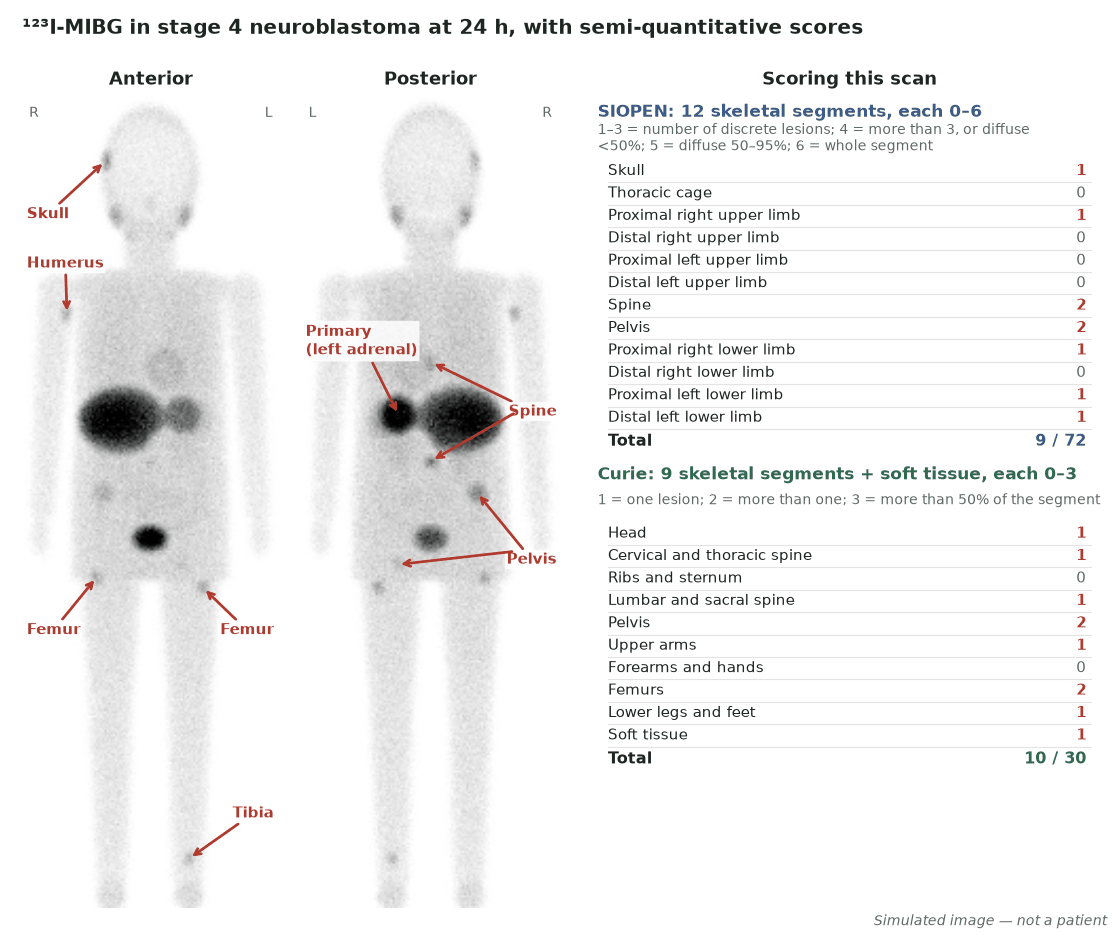
¹²³I-MIBG is central to neuroblastoma: it stages disease, quantifies skeletal and soft-tissue burden with semi-quantitative scores (e.g. SIOPEN/Curie), assesses response, and identifies candidates for ¹³¹I-MIBG therapy — a paediatric theranostic. FDG PET is the standard alternative for MIBG-non-avid tumours (revised INRC 2017); ¹⁸F-DOPA and ⁶⁸Ga-DOTA-peptide PET are complementary options.
Neuroblastoma arises from neural-crest tissue and usually takes up MIBG, making it both a staging tool and a treatment target. Standardised scoring allows objective response assessment.
When to image
- Staging at diagnosis and assessing treatment response.
- Detecting relapse.
- Selecting patients for ¹³¹I-MIBG therapy.
How to read it
- Score skeletal and soft-tissue uptake with a validated system for objective comparison.
- Correlate with anatomical imaging and marrow studies.
- MIBG-non-avid disease → assess with FDG PET (INRC 2017); ¹⁸F-DOPA or ⁶⁸Ga-DOTA-peptide PET as complementary options.
Protocol
- Thyroid blockade; review interfering medications.
- ¹²³I-MIBG whole-body planar/SPECT(-CT) at ~24 h; weight-based dosing (5.2 MBq/kg, minimum 37 MBq, maximum 370–400 MBq).
- Consistent technique for serial scoring.
Pitfalls
- Some neuroblastomas do not take up MIBG.
- Drug interference and physiological uptake.
- Scoring requires standardisation for valid comparison.
Evidence & guidelines
- EANM neuroblastoma imaging guideline (Bar-Sever et al., Eur J Nucl Med Mol Imaging 2018;45:2009–2024); SIOPEN scoring (Lewington et al., 2017); revised INRC (Park et al., J Clin Oncol 2017;35:2580–2587).
- MIBG avidity selects ¹³¹I-MIBG therapy candidates.
In depth
- ~90% of neuroblastomas are MIBG-avid, so ¹²³I-MIBG whole-body (± SPECT/CT) is the cornerstone; ~10% are non-avid.
- Curie score: 9 skeletal segments plus 1 soft-tissue region, each scored 0–3 (maximum 30); SIOPEN score: 12 skeletal segments, each scored 0–6 (maximum 72).
- After induction chemotherapy, a Curie score ≤2 or a SIOPEN skeletal score ≤3 predicts better event-free survival, while higher scores identify patients with very poor outcomes who may need alternative strategies.
- A prospective trial reported ¹²³I-MIBG sensitivity 88–93% and specificity 83–92%, with false negatives mainly in minimal residual disease.
- ⁶⁸Ga-DOTATATE PET can show more disease than ¹²³I-MIBG in high-risk neuroblastoma (bone involvement in 97% vs 81% of patients in one series comparing PET with planar MIBG), and the two tracers give complementary information.
- ¹⁸F-FDG PET helps when MIBG is negative or discordant: in one selected series, sensitivity was 78% for FDG versus 50% for ¹²³I-MIBG, and 85% when combined.
- ¹³¹I-MIBG therapy (β⁻ and γ emitter, half-life 8 days) is established for relapsed or refractory high-risk neuroblastoma and is being tested in front-line therapy; about 12 mCi/kg (444 MBq/kg) is the usual maximum without stem-cell support, and ¹⁷⁷Lu-DOTATATE is feasible in relapsed or refractory disease.
Sources: PMID 29938300 (EANM neuroblastoma imaging guideline 2018) · PMID 28887399 · PMID 28940046 · PMID 28887399 (Yanik 2018) · PMID 28940046 (Ladenstein 2018) · PMID 19185008 (Vik 2009) · PMID 32796449 (Gains 2020) · PMID 21617976 (Melzer 2011)
- Abdominal mass and limp in a 3-year-old girl · Advanced
Spotted an error or something out of date? Report an error