Paediatric Considerations
Children need the right test (non-ionising first where it answers the question), the lowest activity that still gives a diagnostic image, and a child-centred technique. Activity is scaled by weight with minimum activities that protect image quality in the smallest patients. Europe uses the EANM dosage card, North America the consensus guidelines, and the UK ARSAC's fraction-of-adult table.
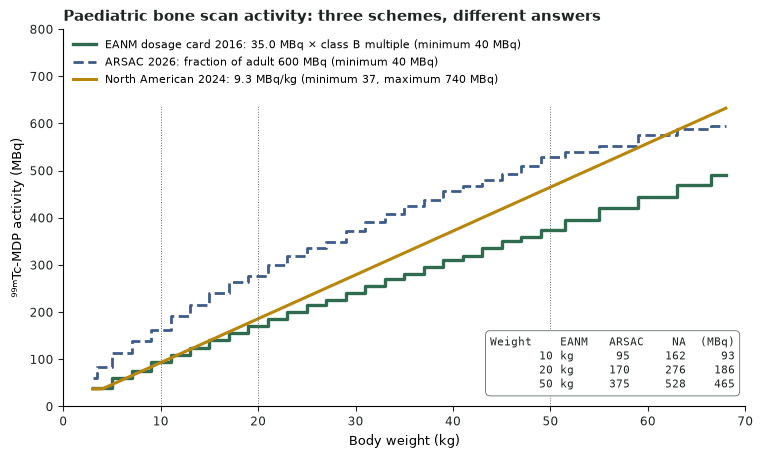
The three schemes differ in intent. The EANM card aims at a weight-independent effective dose. ARSAC scales the adult activity to keep count density, so the effective dose per kilogram is higher than in adults. The North American guidelines give MBq/kg with minimum and maximum activities. For a bone scan in a 20-kg child the answers range from 170 to 276 MBq (see the figure). Always weigh the child. The calculators page includes a paediatric activity tool.
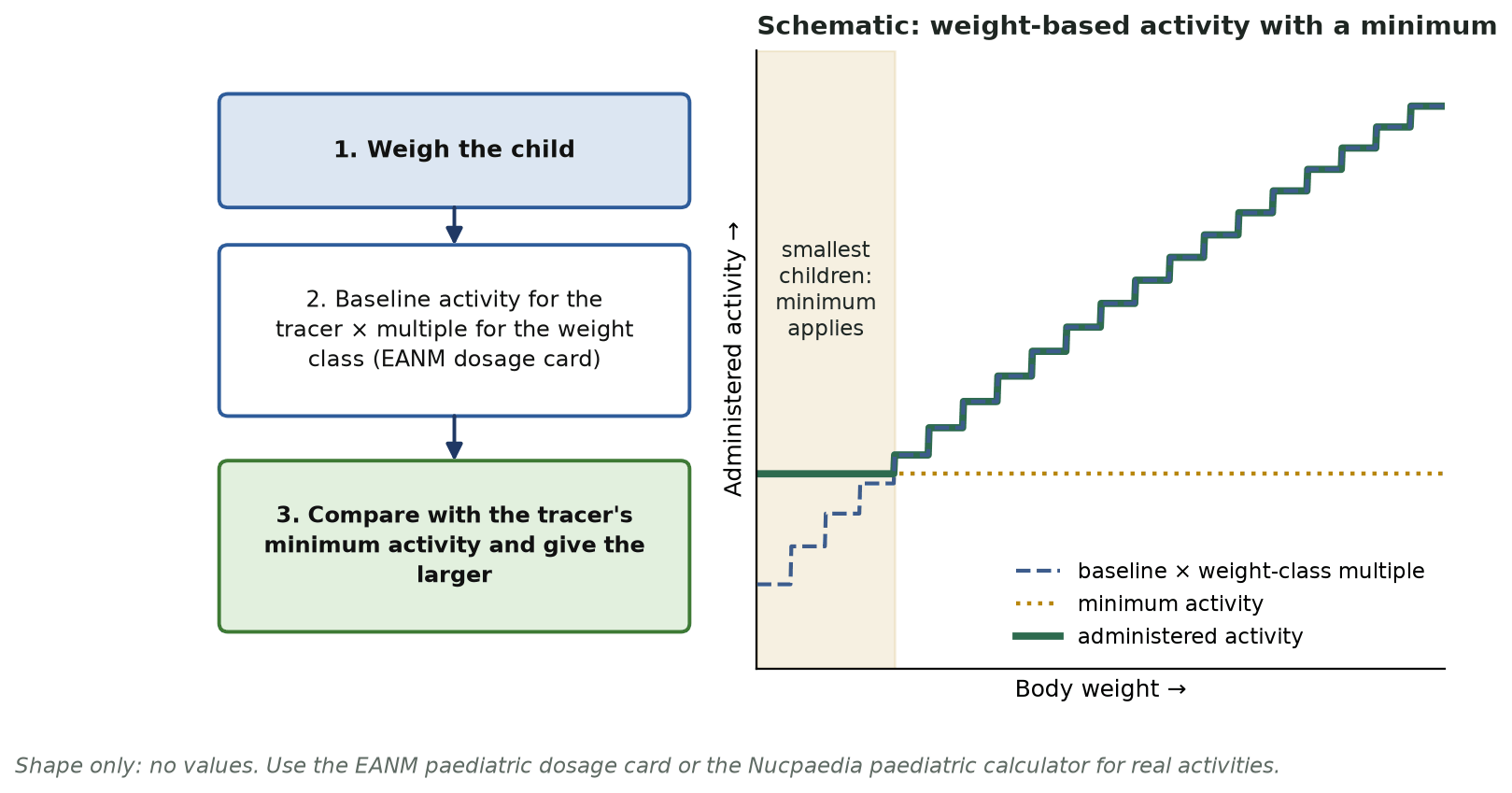
- EANM dosage card (version 5.7.2016): activity = baseline activity × weight-class multiple (class A renal agents, B most tracers, C radioiodine for thyroid); if the result is below the minimum recommended activity, give the minimum.
- EANM examples: ⁹⁹ᵐTc-MDP baseline 35.0 MBq, minimum 40 MBq; ⁹⁹ᵐTc-DMSA 6.8 and 18.5 MBq; ⁹⁹ᵐTc-MAG3 (class A) 11.9 and 15 MBq; ¹⁸F-FDG torso 25.9 and 26 MBq; ¹²³I-mIBG 28.0 and 37 MBq. Class B multiples run from 1 at 3 kg to 14.0 at 68 kg.
- North American 2024 update: ⁹⁹ᵐTc-MDP 9.3 MBq/kg (minimum 37, maximum 740 MBq); ¹⁸F-FDG body 2.96–5.2 MBq/kg (26–370 MBq); ⁹⁹ᵐTc-DMSA 1.85 MBq/kg (18.5–100 MBq); ⁹⁹ᵐTc-MAG3 3.7 MBq/kg (37–148 MBq); ¹²³I-mIBG 5.2 MBq/kg (37–370 MBq).
- UK (ARSAC 2026): fraction of adult activity by weight — 0.10 at 3 kg, 0.27 at 10 kg, 0.46 at 20 kg, 0.88 at 50 kg; never below 10% of the adult activity; procedure minima include bone 40 MBq, DMSA 15 MBq, MAG3 15 MBq and ¹²³I-mIBG 70 MBq. FDG for tumour imaging is scaled by weight as for adults.
- Thyroid blocking in children (ARSAC): 12.5% of the adult dose from birth to 1 month, 25% from 1 month to 3 years, 50% from 3 to 12 years; potassium perchlorate 10 mg/kg (minimum 50, maximum 500 mg) 30–60 min before the tracer.
DMSA for a 10-kg child: when the minimum applies
Given. A 10-kg child is referred for ⁹⁹ᵐTc-DMSA. EANM: baseline 6.8 MBq, class B multiple at 10 kg 2.71, minimum 18.5 MBq. North America: 1.85 MBq/kg, minimum 18.5 MBq. UK: adult diagnostic reference level 80 MBq, fraction at 10 kg 0.27, minimum 15 MBq.
- EANM: 6.8 × 2.71 = 18.4 MBq, which is below the 18.5 MBq minimum, so give 18.5 MBq.
- North America: 1.85 × 10 = 18.5 MBq, which equals the minimum.
- UK: 0.27 × 80 = 21.6 MBq, above the 15 MBq minimum and above 10% of the adult activity (8 MBq), so give about 22 MBq.
Answer. About 18.5 MBq by the EANM and North American schemes, and about 22 MBq by the ARSAC table. In the smallest children the minimum activity, not the weight, sets the dose.
Justification and planning
- Choose the test that answers the question with the least radiation, and use ultrasound or MRI where they are available in a clinically useful time (ARSAC). Consider referral to a specialist paediatric centre.
- Book at least 50% more time than for the equivalent adult study; delays make children less cooperative.
- Give parents written information in advance and explain the procedure to the child and the accompanying adult on the day.
Dosing
- Always weigh the child; do not estimate. The local procedure must say how weights between the listed categories are handled.
- Europe: EANM dosage card, baseline activity × weight-class multiple, with a minimum activity for each tracer. North America: MBq/kg with minimum and maximum activities (2024 update). UK: ARSAC fraction-of-adult table and minimum activities.
- The minimum activities assume standard gamma cameras and PET scanners. Systems with higher counting efficiency, such as digital or long-axial-field PET, may justify activities at or below the lower end.
- National diagnostic reference levels should not be exceeded (EANM dosage card).
Technique and care
- Use a child-friendly environment, distraction, and feeding and wrapping for infants. Use immobilisation aids.
- A cooperative child in adequate pain relief rarely needs sedation. When sedation or anaesthesia is needed for a long study, decide individually and consider its effect on function, particularly for SPECT and PET/CT (ARSAC; RCR guidance).
- Use paediatric-specific protocols: for a bone scan, image the limbs separately from the trunk, or add spot views of the knees and any abnormal area to a whole-body sweep (ARSAC).
Radiation protection
- For renally excreted tracers, encourage fluids, active bladder emptying and frequent nappy changes to lower bladder and gonadal dose.
- Block the thyroid when a radioiodinated agent such as ¹²³I-mIBG is used, at the reduced paediatric dosage.
- Parents who hold or comfort the child are carers and comforters, covered by dose constraints (see regulation & release).
- Therapy in children belongs in centres with round-the-clock paediatric staff, facilities for anaesthesia if needed, and patient-specific dosimetry, which ARSAC regards as essential.
Interpretation
- Symmetric growth-plate and apophyseal uptake is normal; asymmetry or a focal abnormality is the clue. See paediatric bone.
- Unossified cartilage appears cold.
- Image the whole body when osteomyelitis is suspected, because it can be multifocal, particularly in neonates.
In depth
- The EANM card rests on Jacobs et al. (2005), who derived tracer-dependent multiples to give effective doses independent of body weight. That is why the class B multiple at 68 kg is 14.0 rather than about 23 (68/3).
- ARSAC's fraction-of-adult table keeps image count density and imaging time close to the adult study. ARSAC states openly that the effective dose per unit weight is then higher than in adults.
- Worked EANM example from the card: FDG brain in a 50-kg child is 14.0 × 10.71 ≈ 150 MBq. ¹²³I-mIBG in a 3-kg infant calculates to 28 MBq, so the 37 MBq minimum is given.
- North American guidance for patients over 70 kg: the maximum should not exceed weight × the MBq/kg figure. Some centres cap at 70 × MBq/kg, for example about 648 MBq for ⁹⁹ᵐTc-MDP.
- The 2024 North American update replaced the 2016 table. It changed 9 protocols and added 6, five of them PET: ¹³NH₃, ⁸²Rb, ¹⁸F-FDOPA, ⁶⁸Ga-DOTATATE, ⁶⁸Ga-DOTATOC and ¹²³I-NaI for thyroid cancer.
- The EANM and SNMMI harmonised their schemes in 2014, adjusting both so that most tracers give similar activities, and a revised EANM card was issued with that work.
- Potassium perchlorate in children (ARSAC): a second dose can be given late on the same day, and a third the next morning if the thyroid is still visible at scanning.
Sources: EANM dosage card v5.7.2016 · Lassmann & Treves 2014 (PMID 24599377) · Treves 2016 (PMID 27909182); 2024 update summary (Treves, J Nucl Med 2026) · ARSAC Notes for Guidance (July 2026), section 6 and Table 8.1
Sources
- European Association of Nuclear Medicine. Dosage Card (version 5.7.2016). EANM; 2016.
- Lassmann M, Treves ST. Paediatric radiopharmaceutical administration: harmonization of the 2007 EANM paediatric dosage card (version 1.5.2008) and the 2010 North American consensus guidelines. Eur J Nucl Med Mol Imaging. 2014;41:1036–1041.
- Treves ST, Gelfand MJ, Fahey FH, Parisi MT. 2016 update of the North American consensus guidelines for pediatric administered radiopharmaceutical activities. J Nucl Med. 2016;57(12):15N–18N.
- Treves ST, Fahey FH, Ferrer Valencia V, et al. Summary of the 2024 update of the North American guidelines for pediatric administered radiopharmaceutical activities. J Nucl Med. 2026;67:341–342.
- Jacobs F, Thierens H, Piepsz A, et al. Optimized tracer-dependent dosage cards to obtain weight-independent effective doses. Eur J Nucl Med Mol Imaging. 2005;32:581–588.
- Administration of Radioactive Substances Advisory Committee. Notes for guidance on the clinical administration of radiopharmaceuticals and use of sealed radioactive sources. UK Health Security Agency; July 2026.