Departmental Radiation Safety
Departmental radiation safety turns ICRP principles and national law into daily routine: prior risk assessment, designated controlled and supervised areas, personal dosimetry, contamination monitoring, spill procedures, care with volatile radioiodine, and segregated waste. Time, distance and shielding remain the everyday tools. The legal framework, therapy-patient release, waste rules and transport are covered in regulation, patient release & transport.
Responsibilities are named. In the UK, the employer consults a radiation protection adviser (RPA), appoints radiation protection supervisors (RPSs) and writes local rules under IRR17; a medical physics expert (MPE) advises on patient exposures under IR(ME)R. In the US, a radiation safety officer (RSO) oversees work under the NRC or Agreement State licence, and authorised users sign written directives.
- UK controlled area (IRR17 reg 17): anyone likely to exceed 6 mSv/year effective, 15 mSv lens or 150 mSv skin or extremities, or special procedures needed. The ACOP adds dose rate >7.5 µSv/h averaged over the working day, hand dose rate >75 µSv/h (8-h mean), or a risk of spreading significant contamination.
- UK supervised area: likely >1 mSv/year effective, >5 mSv lens, or >50 mSv skin or extremities. Classified workers: likely >6 mSv/year, or >3/10 of an equivalent-dose limit.
- US personal monitoring (10 CFR 20.1502): adults likely to exceed 10% of a limit; declared pregnant workers likely to exceed 1 mSv during the pregnancy.
- US surveys: dose-rate survey at the end of each day of use (10 CFR 35.70); removable-contamination wipes weekly in elution, preparation, assay and administration areas, monthly where only <7.4 MBq (200 µCi) is used (NUREG-1556 Vol 9, App R).
- US restricted-area trigger levels for removable contamination: 2,000 dpm/100 cm² for ¹³¹I, ¹²³I, ¹¹¹In, ¹⁷⁷Lu and ⁹⁰Y; 20,000 dpm/100 cm² for ⁹⁹ᵐTc, ⁶⁷Ga and ²⁰¹Tl; 200 dpm/100 cm² for alpha emitters.
- Major-spill thresholds (NUREG-1556 Vol 9, App N): ⁹⁹ᵐTc, ¹⁸F and ²⁰¹Tl 3,700 MBq; ¹¹¹In, ¹²³I and ⁶⁷Ga 370 MBq; ¹³¹I, ⁹⁰Y and ³²P 37 MBq; any alpha emitter.
- Pregnant staff: fetal dose unlikely to exceed 1 mSv for the rest of the pregnancy (IRR17, as Euratom); US declared pregnant worker 5 mSv over the whole pregnancy. Breastfeeding staff: no work with significant risk of intake or bodily contamination (IRR17).
Areas, rules and access
- Make a radiation risk assessment before new work starts, with the RPA (UK) or RSO (US), and repeat it when practice changes, for example when a new therapy is introduced.
- Designate controlled and supervised areas from that assessment. Post signs and restrict access: in the UK only classified persons, or others under written arrangements, may enter a controlled area, and the local rules summarise those arrangements.
- Keep radioactive substances in secure, shielded, labelled stores, and record receipt, use and disposal so that every source can be accounted for.
Staff dose monitoring
- Issue body dosimeters where doses could approach the classification or monitoring thresholds. Radiopharmacy and therapy preparation also need extremity (ring or fingertip) dosimeters, because the hands receive the highest doses.
- Use the lens limit that applies locally: 20 mSv/year under Euratom and IRR17, 150 mSv under the NRC.
- Where millicurie quantities of volatile radioiodine are handled — dispensing from vials, preparing capsules from solution — run a thyroid bioassay programme with action levels (NUREG-1556).
- Once pregnancy is declared, review the work so that the fetal dose stays within the limit. Pregnancy does not by itself prevent work with radiation. A breastfeeding employee should not do work carrying a significant risk of intake or contamination.
Contamination and spills
- Monitor hands, clothing and shoes before leaving an area, and wipe-test work surfaces routinely. Unrestricted areas are decontaminated to background wherever possible.
- Minor spill: warn people nearby, cover with absorbent paper, wear gloves and overshoes, and clean from the edge towards the centre. Bag the waste, re-survey until below trigger levels, then report to the RSO or RPS.
- Major spill: clear the room, cover without cleaning, mark the boundary and lock or post the room. Call the RSO or RPA at once, and survey and decontaminate people with lukewarm water and mild soap. First aid for any injury is never delayed because of contamination.
- Short-lived spills (half-life under 24 h, small activity) can sometimes be handled by restricting access until decay.
Radioiodine, therapy and waste
- Handle volatile ¹³¹I in a fume cupboard or other ventilated containment. Keep therapy rooms, toilets and waste under local rules, with routine contamination surveys after discharge.
- Excreta: in the US, excreta from patients are exempt from sewer-release limits (10 CFR 20.2003). Some European countries require delay tanks; ICRP 94 found that storing patients' urine gives minimal benefit.
- Segregate solid waste by half-life, store it shielded and labelled, and release it only after a survey shows it cannot be distinguished from background. Long-lived impurities such as ¹⁷⁷ᵐLu, or generator-column contaminants, may prevent simple decay-in-storage.
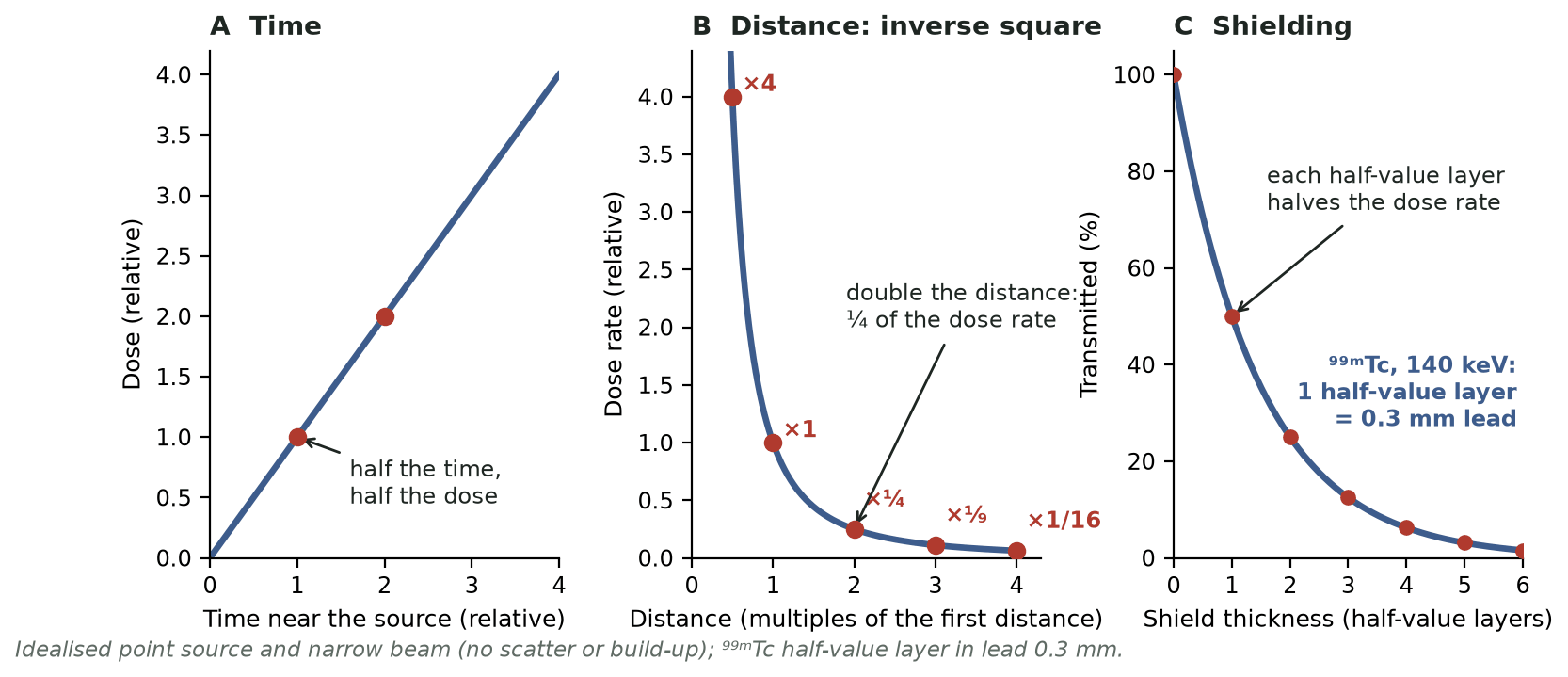
- Time, distance and shielding: halve the time, double the distance (a quarter of the dose rate), and use syringe shields and tongs. One half-value layer for ⁹⁹ᵐTc (140 keV) is about 0.3 mm of lead.
Pitfalls
- Contamination missed because monitoring is irregular, or the monitor is not suited to the radionuclide.
- Extremity dose underestimated by a ring worn on the wrong finger or the wrong hand.
- ¹⁷⁷Lu waste from carrier-added product stored as if it were a pure 6.6-day nuclide.
- Therapy patients discharged without written instructions (see patient release).
In depth
- Hand doses dominate in radionuclide therapy. During ¹⁷⁷Lu-DOTATATE labelling, the highest dose was to the right middle finger of right-handed workers, 53 ± 12 µSv/GBq. For 400 preparations of 7.4 GBq shared by 4 workers, that meant a fingertip dose of about 23 mSv and a ring dose of 14 mSv each, but an effective dose of only 0.5–1.5 mSv.
- IRR17 lets the lens limit be applied as 100 mSv over 5 consecutive years, with no more than 50 mSv in any one year, under conditions approved by the HSE. The default is 20 mSv in a calendar year.
- IRR17 regulation 24: after an accident likely to give more than 6 mSv effective, 15 mSv to the lens or 150 mSv to the skin or extremities, the employer must arrange a dose assessment.
- NUREG-1556 Vol 9 decides between a major and a minor spill by the radionuclide's lowest annual limit on intake. For half-lives under 24 h and less than 5 ALI, restricting access pending decay is an accepted alternative.
- NRC acceptable removable contamination for unrestricted areas is far stricter than in restricted areas: 200 dpm/100 cm² for ¹³¹I, against 2,000 dpm/100 cm² in a restricted area.
- The NRC notes that ¹⁵³Sm, ⁹⁹Mo/⁹⁹ᵐTc generator columns and ⁹⁰Y microspheres may contain long-lived contaminants that preclude decay-in-storage, even though the principal nuclide is short-lived.
Sources: Bakker 2006 (PMID 17043624) · HSE L121, IRR17 ACOP (2018) · NUREG-1556 Vol 9 Rev 3 (2019), App N and R · 10 CFR 20 and 35 · ICRP 94 (2004)
Sources
- Health and Safety Executive. Work with ionising radiation. Ionising Radiations Regulations 2017. Approved Code of Practice and guidance (L121), 2nd edition. HSE; 2018.
- US Nuclear Regulatory Commission. Consolidated guidance about materials licenses: program-specific guidance about medical use licenses. NUREG-1556, Volume 9, Revision 3. 2019.
- US Nuclear Regulatory Commission. 10 CFR Part 20, Standards for protection against radiation, and 10 CFR Part 35, Medical use of byproduct material.
- International Commission on Radiological Protection. Release of patients after therapy with unsealed radionuclides. ICRP Publication 94. Ann ICRP. 2004;34(2).
- Bakker WH, Breeman WAP, Kwekkeboom DJ, De Jong LC, Krenning EP. Practical aspects of peptide receptor radionuclide therapy with [¹⁷⁷Lu][DOTA⁰,Tyr³]octreotate. Q J Nucl Med Mol Imaging. 2006;50:265–271.
- Council of the European Union. Council Directive 2013/59/Euratom laying down basic safety standards for protection against the dangers arising from exposure to ionising radiation. Official Journal of the European Union. 2014;L13:1–73.