Radionuclide Production
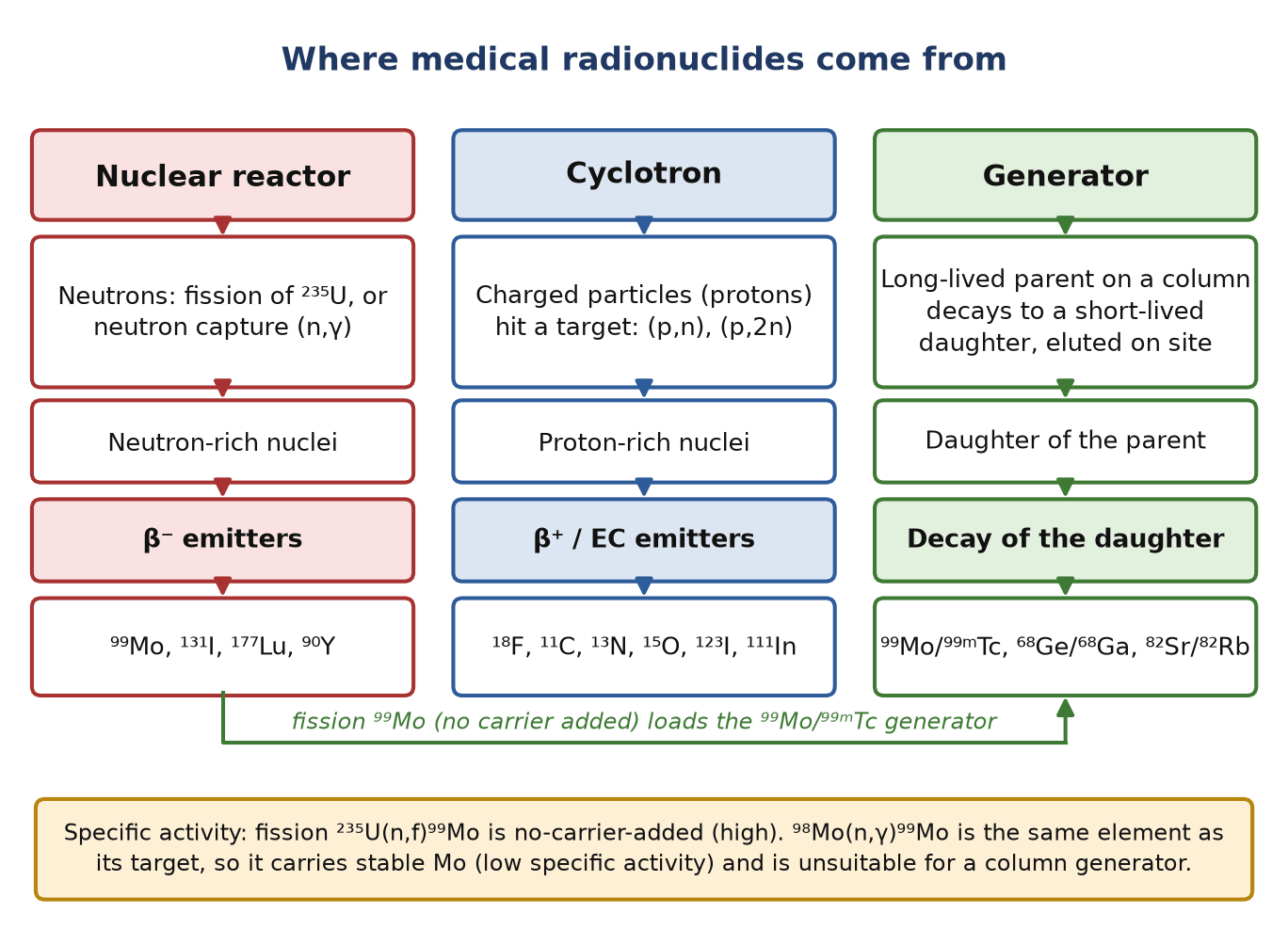
Medical radionuclides come from three sources: nuclear reactors (neutron-rich, decay by β⁻ — e.g. ⁹⁹Mo, ¹³¹I, ¹⁷⁷Lu), cyclotrons (proton-rich, decay by β⁺/EC — e.g. ¹⁸F, ¹¹C, ¹²³I), and generators (a long-lived parent decays to a short-lived daughter eluted on site — ⁹⁹Mo/⁹⁹ᵐTc, ⁶⁸Ge/⁶⁸Ga, ⁸²Sr/⁸²Rb).
The production route determines a nuclide’s decay mode, availability, and specific activity. Generators bring short-lived isotopes to centres without a reactor or cyclotron.
- Cyclotron products are neutron-deficient and decay by β⁺ or electron capture (e.g. ¹⁸F, ⁶⁷Ga, ¹²³I, ¹¹¹In).
- Reactor fission of ²³⁵U releases about 200 MeV and 2–3 neutrons per fission; research-reactor thermal flux is about 10¹¹–10¹⁴ n/cm²·s.
- Fission ⁹⁹Mo is no-carrier-added (about 6% of fission products have mass 99); fission contaminants include ¹³¹I, ¹⁰³Ru, ⁸⁹Sr and ⁹⁰Sr.
- (n,γ) capture (⁹⁸Mo(n,γ)⁹⁹Mo) gives the same element as the target, so the product carries stable Mo and has low specific activity — too low for a conventional alumina-column generator.
- Carrier-free specific activity: ⁹⁹ᵐTc 5.27×10⁶ mCi/mg, ¹³¹I 1.24×10⁵ mCi/mg, ¹¹¹In 4.2×10⁵ mCi/mg.
- Specific activity of a carrier-free nuclide (mCi/mg) ≈ 3.13×10⁹ / (A × T½ in hours).
- Simple cyclotron example: ¹¹¹Cd(p,n)¹¹¹In with 12-MeV protons; ¹⁸F comes from ¹⁸O(p,n)¹⁸F on [¹⁸O]water.
- Shorter half-life means higher specific activity (SA ∝ 1/T½ for a given mass number).
Specific activity of carrier-free ¹¹¹In
Given. ¹¹¹In, T½ = 67 h, A = 111.
- N in 1 mg = 6.02×10²³×10⁻³/111
- λ = 0.693/(67·3600) s⁻¹
- A = λN ≈ 1.56×10¹³ dps = 4.22×10⁵ mCi
- Check: 3.13×10⁹/(111·67) ≈ 4.21×10⁵ mCi/mg
Answer. ≈ 4.22×10⁵ mCi/mg.
Production routes
| Method | Mechanism | Examples |
|---|---|---|
| Reactor | Fission or neutron activation (neutron-rich → β⁻) | ⁹⁹Mo, ¹³¹I, ¹⁷⁷Lu, ⁹⁰Y |
| Cyclotron | Charged-particle bombardment (proton-rich → β⁺/EC) | ¹⁸F, ¹¹C, ¹³N, ¹⁵O, ¹²³I, ⁶⁸Ga (cyclotron) |
| Generator | Long-lived parent → short-lived daughter, eluted | ⁹⁹Mo/⁹⁹ᵐTc, ⁶⁸Ge/⁶⁸Ga, ⁸²Sr/⁸²Rb |
Key concepts
- Specific activity = activity per mass; ‘carrier-free’/no-carrier-added preparations maximise it.
- Fission ⁹⁹Mo gives high specific activity; neutron-activation ⁹⁹Mo is lower.
- Cyclotron isotopes are usually short-lived, needing on-site or nearby production.
Pitfalls
- Short half-lives (¹¹C 20 min, ⁶⁸Ga 68 min) constrain logistics.
- Reactor-supply interruptions have caused ⁹⁹Mo shortages.
- Radionuclidic impurities from the production route must be controlled.
In the clinic — why the physics matters
- Fission ⁹⁹Mo (no carrier added) loads the standard alumina-column generator; low-specific-activity (n,γ) ⁹⁹Mo needs other separation technology.
- Cyclotron nuclides provide the 511-keV PET tracers (¹⁸F-FDG, ¹¹C, ¹³N, ¹⁵O).
- High specific (molar) activity matters for receptor and peptide imaging, because unlabelled molecules compete for the same binding sites.
- Global ⁹⁹Mo supply depends on a few ageing research reactors, so outages cause ⁹⁹ᵐTc shortages — one driver for cyclotron ¹⁰⁰Mo(p,2n)⁹⁹ᵐTc production.
Cyclotron vs reactor production
| Feature | Cyclotron | Reactor |
|---|---|---|
| Particle | charged (p, d, α) | thermal neutrons |
| Reaction | (p,n), (p,2n)… | fission (n,f), capture (n,γ) |
| Product | neutron-deficient | neutron-rich |
| Decay | β⁺/EC | β⁻ |
| Carrier-free? | yes/NCA | fission yes; (n,γ) no |
| Examples | ¹¹¹In, ⁶⁷Ga, ¹²³I, ¹⁸F | ⁹⁹Mo, ¹³¹I, ¹³³Xe, ⁹⁰Sr |
Common pitfalls & misconceptions
- 'Carrier-free' is practically impossible — the honest term is 'no carrier added' (NCA).
- Specific activity (per mass) ≠ concentration (per volume).
- An (n,γ) product is the same element as the target → not carrier-free, low SA.
- Counter-intuitively, shorter half-life gives higher specific activity (SA ∝ 1/T½).
In depth
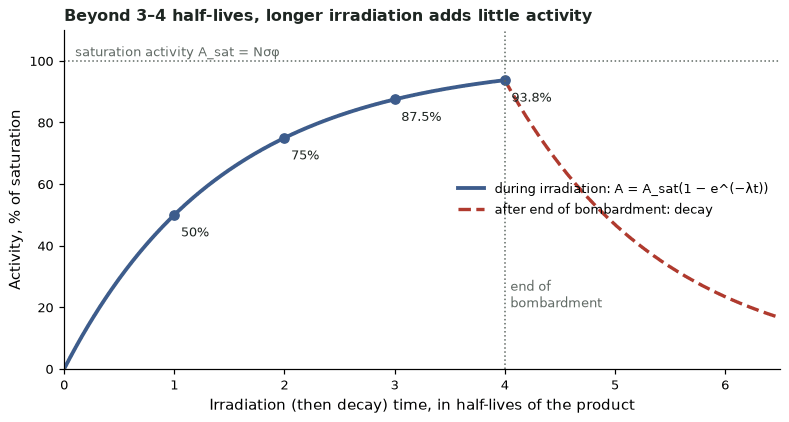
- Activation follows A = Nσφ(1 − e^(−λt)): activity approaches the saturation value Nσφ, reaching 50% after one half-life of irradiation, 75% after two and about 94% after four, so irradiating much longer than 3–4 half-lives of the product adds little.
- ¹⁷⁷Lu has two reactor routes. Direct ¹⁷⁶Lu(n,γ)¹⁷⁷Lu is carrier-added and co-produces long-lived ¹⁷⁷ᵐLu (T½ about 160 d), a waste and contamination issue. Indirect ¹⁷⁶Yb(n,γ)¹⁷⁷Yb (T½ 1.9 h) → ¹⁷⁷Lu gives no-carrier-added ¹⁷⁷Lu free of ¹⁷⁷ᵐLu but needs a difficult Lu/Yb chemical separation.
- Two ¹⁸F routes give different chemistry. ¹⁸O(p,n)¹⁸F on enriched [¹⁸O]water yields no-carrier-added [¹⁸F]fluoride for nucleophilic labelling (FDG). ²⁰Ne(d,α)¹⁸F with added F₂ yields carrier-added [¹⁸F]F₂ for electrophilic labelling, with low specific activity and at most 50% of the ¹⁸F incorporated into the product.
- Cyclotron ⁹⁹ᵐTc: irradiating sintered ¹⁰⁰Mo targets with 18-MeV protons on a medical cyclotron for up to about 7 h produced up to 348 GBq (9.4 Ci) of ⁹⁹ᵐTc that passed standard QC and labelled the usual kits. It avoids uranium and reactor waste, but the 6-h half-life ties supply to the local region and trace Mo isotopes in the target co-produce other Tc isotopes that must be controlled.
- The fission route explains the eluate specifications: the Ph. Eur. fission-pertechnetate monograph limits ⁹⁹Mo to 0.1%, ¹³¹I and ¹⁰³Ru to 5×10⁻³ %, ⁸⁹Sr to 6×10⁻⁵ %, ⁹⁰Sr to 6×10⁻⁶ % and α emitters to 1×10⁻⁷ % of total radioactivity (see the generator page).
- Generator pairs need a parent that outlives the daughter: ⁶⁸Ge (T½ 271 d) → ⁶⁸Ga (68 min) and ⁸²Sr (25 d) → ⁸²Rb (75 s). Parent breakthrough is the key radionuclidic impurity, for example ⁶⁸Ge ≤0.001% for the licensed ⁶⁸Ga-DOTATATE kit and ⁸²Sr/⁸⁵Sr limits for ⁸²Rb.
- The specific-activity constant follows from A = λN: (ln2 × 6.022×10²³)/(3600 s × 1000 mg/g × 3.7×10⁷ Bq/mCi) = 3.13×10⁹, so SA (mCi/mg) = 3.13×10⁹/(A·T½[h]); for ⁹⁹ᵐTc (A 99, T½ 6.01 h) this gives 5.27×10⁶ mCi/mg.
Sources: Saha, Fundamentals of Nuclear Pharmacy, 7th ed. (2018), Ch. 4 · Dash et al. 2015 (PMID 26085854) · Yu 2006 (PMID 21614337) · Bénard et al. 2014 (PMID 24722529) · Ph. Eur. monograph 0124 · NETSPOT US label (2023); 10 CFR 35.204
Sources
- Saha GB. Fundamentals of Nuclear Pharmacy. 7th ed. Cham: Springer; 2018.
- Cherry SR, Sorenson JA, Phelps ME. Physics in Nuclear Medicine. 4th ed. Philadelphia: Elsevier Saunders; 2012.
- International Atomic Energy Agency. Cyclotron Produced Radionuclides: Physical Characteristics and Production Methods. Technical Reports Series No. 468. Vienna: IAEA; 2009.
- Dash A, Pillai MRA, Knapp FF. Production of ¹⁷⁷Lu for targeted radionuclide therapy: available options. Nucl Med Mol Imaging. 2015;49:85–107.
- Bénard F, Buckley KR, Ruth TJ, et al. Implementation of multi-curie production of ⁹⁹ᵐTc by conventional medical cyclotrons. J Nucl Med. 2014;55:1017–22.
- Yu S. Review of ¹⁸F-FDG synthesis and quality control. Biomed Imaging Interv J. 2006;2:e57.
- European Pharmacopoeia. Sodium pertechnetate (⁹⁹ᵐTc) injection (fission), monograph 0124. Strasbourg: EDQM (current edition).