Radiopharmaceutical Quality Control
Before release, every radiopharmaceutical is checked for radiochemical purity (the fraction of activity in the desired chemical form — by chromatography), radionuclidic purity (correct isotope; e.g. ⁹⁹Mo breakthrough), chemical purity (e.g. aluminium), plus apyrogenicity (endotoxin), pH and, for particulates, particle size; sterility testing of short-lived products is completed after release.
QC protects the patient from impurities that degrade images (biodistribution errors) or cause harm. Some tests are performed on every batch, others periodically.
- Radionuclidic purity = fraction of activity that is the desired nuclide; radiochemical purity = fraction in the desired chemical form; chemical purity concerns non-radioactive species (e.g. aluminium).
- ⁹⁹Mo breakthrough limit: 0.15 µCi/mCi ⁹⁹ᵐTc at administration (USP/NRC), measured through a lead pot that passes only the 740/778-keV photons; Ph. Eur. 0.1%.
- Aluminium limit: 10 µg/mL of eluate (USP); 5 µg/mL (Ph. Eur.).
- Sterilising filtration uses a validated 0.22-µm (0.2-µm) membrane with an integrity (bubble-point or pressure-hold) test after use; 0.45-µm filters are not sterilising grade.
- Sterility test: fluid thioglycollate medium at 30–35 °C and soya-bean casein digest medium at 20–25 °C for 14 days.
- Endotoxin limit for radiopharmaceuticals 175/V EU per mL (V = maximum dose volume); general parenteral limit 5.0 EU/kg, intrathecal 0.2 EU/kg.
- Ideal product pH is 7.4 (tolerated range about 2–9 thanks to blood buffering); pertechnetate eluate pH 4.5–7.5 (USP).
- Dose calibrator: AAPM Report 181 action level ±5% for constancy, accuracy and linearity (older US NRC guidance allowed ±10%); see counting statistics and the dose calibrator.
Radiochemical purity by two-strip ITLC
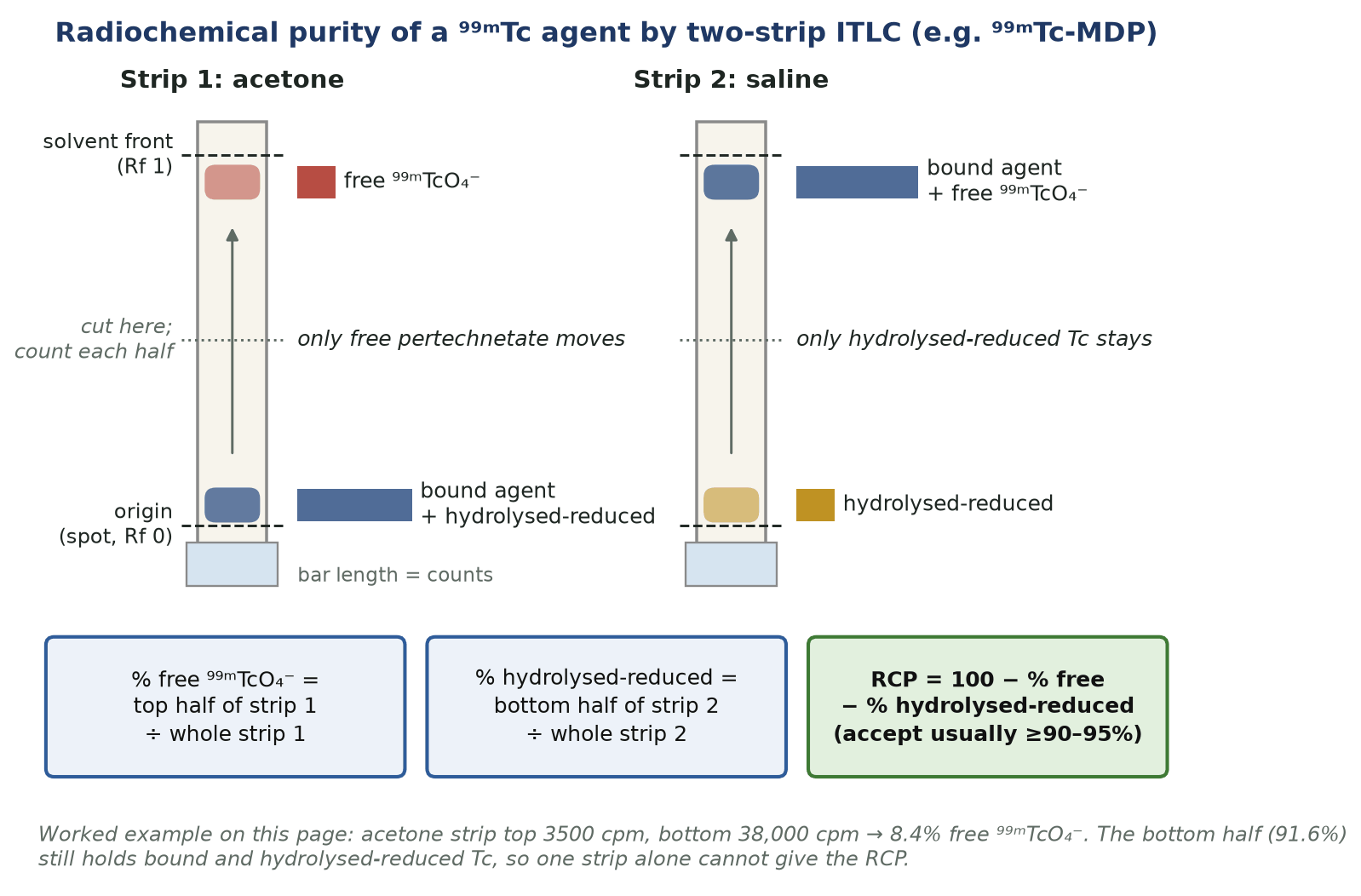
Given. ⁹⁹ᵐTc-MDP. Strip 1 (ITLC-SG, acetone): solvent front (free TcO₄⁻) 3,500 cpm, origin 38,000 cpm. Strip 2 (ITLC-SG, saline): origin (hydrolysed-reduced Tc) 1,200 cpm, front 40,300 cpm.
- Free pertechnetate = 3,500 / 41,500 = 8.4%.
- Hydrolysed-reduced ⁹⁹ᵐTc = 1,200 / 41,500 = 2.9%.
- RCP = 100 − 8.4 − 2.9 = 88.7%.
Answer. RCP ≈ 89% — below the >95% expected for MDP, so the preparation should not be released; free pertechnetate is the main impurity (look for oxidation or too little tin).
Endotoxin limit for an FDG dose
Given. Endotoxin limit 175/V EU/mL; maximum dose volume V = 10 mL; patient 70 kg; general limit 5 EU/kg.
- Limit = 175/10 = 17.5 EU/mL.
- A full 10-mL dose at the limit contains 175 EU.
- 175 EU / 70 kg = 2.5 EU/kg.
Answer. 17.5 EU/mL; even a full dose at the limit gives 2.5 EU/kg, within the 5 EU/kg threshold for pyrogenic reactions.
Purity tests
- Radiochemical purity by ITLC or paper chromatography separates free pertechnetate and hydrolysed-reduced ⁹⁹ᵐTc from the labelled complex; acceptance is usually >90–95% (>80% for exametazime).
- Radionuclidic purity: ⁹⁹Mo breakthrough (USP/NRC ≤0.15 kBq/MBq at administration; Ph. Eur. ≤0.1%) and the correct photopeak or half-life.
- Chemical purity: aluminium in generator eluate (≤10 µg/mL USP, ≤5 µg/mL Ph. Eur.); for PET products, residual solvents and phase-transfer catalyst (Kryptofix 2.2.2).
Biological & physical
- Sterility (14-day culture) and bacterial endotoxins (LAL test); sterility results for short-lived products are only available after release.
- pH and appearance (clarity, colour, visible particles).
- Particle size and number for ⁹⁹ᵐTc-MAA and particle size for colloids.
Pitfalls
- Low radiochemical purity gives abnormal biodistribution and non-diagnostic scans.
- Skipping the ⁹⁹Mo breakthrough check can give excess patient dose.
- Endotoxin or sterility failures risk pyrogenic reactions and infection; a sterile product can still be pyrogenic.
In the clinic — why the physics matters
- Poor radiochemical purity gives high soft-tissue and blood background and unnecessary dose — so kits are tested by ITLC, at least for each new batch and per local risk assessment.
- Free ⁹⁹ᵐTcO₄⁻ shows thyroid, stomach and salivary uptake; hydrolysed-reduced ⁹⁹ᵐTc shows liver and spleen uptake — each impurity has a recognisable pattern.
- A product can be sterile yet pyrogenic — endotoxin survives normal sterilisation — so endotoxin testing is separate (critical for intrathecal agents).
- Aluminium above the limit flocculates sulfur colloid (lung uptake) and agglutinates red cells.
Radiopharmaceutical QC tests (Saha / USP / Ph. Eur.)
| Test | Method | Acceptance |
|---|---|---|
| ⁹⁹Mo breakthrough | 740/778-keV assay through lead pot | ≤0.15 µCi/mCi at administration (USP); ≤0.1% (Ph. Eur.) |
| Aluminium | colorimetric strip vs standard | ≤10 µg/mL (USP); ≤5 µg/mL (Ph. Eur.) |
| Radiochemical purity | ITLC (acetone + saline) or HPLC | typically ≥90–95% |
| pH | pH meter or validated paper | 4.5–7.5 eluate (USP) |
| Sterility | thioglycollate / soya-bean casein, 14 d | no growth |
| Bacterial endotoxins | LAL gel clot or kinetic chromogenic | 175/V EU/mL; ≤5 EU/kg (0.2 intrathecal) |
| Filter integrity | bubble point / pressure hold | ≥ manufacturer's specification |
Common pitfalls & misconceptions
- Do not confuse the three purities — ⁹⁹Mo is radionuclidic, free TcO₄⁻ is radiochemical, aluminium is chemical.
- A single acetone strip is not the RCP — its origin holds both bound and hydrolysed-reduced Tc; two solvent systems are needed.
- Sterile ≠ apyrogenic — sterilisation does not destroy heat-stable endotoxin.
- A 0.45-µm membrane is not a sterilising filter — sterile filtration needs a validated 0.22-µm filter and a passed integrity test.
In depth
- Two-strip ITLC logic: in acetone (or methyl ethyl ketone) only free pertechnetate migrates; in saline, pertechnetate and soluble complexes migrate and only hydrolysed-reduced ⁹⁹ᵐTc stays at the origin; RCP = 100% − %free − %hydrolysed-reduced. For MAA and colloids the product itself stays at the origin, so filtration or other methods are used instead.
- For ⁹⁹ᵐTc-MAA, Ph. Eur. tests radiochemical purity by filtration (≥90% of radioactivity retained on a 3-µm polycarbonate membrane) and particle size by microscopy (≥90% of particles 10–100 µm, none >150 µm).
- Sterility results for short-lived products arrive after administration. EANM cGRPP recommends in-house sterility testing only for products with half-lives over 7 h; otherwise samples are allowed to decay and are sent to an external laboratory, and operators are qualified by media-fill simulations.
- Endotoxin testing: the traditional LAL gel-clot test takes about 1 h and the kinetic chromogenic test about 15 min, so a pre-release endotoxin result is feasible for cyclotron products and is recommended, particularly when reusable equipment or resin purification is involved.
- The membrane-filter integrity test is the practical pre-release evidence of sterility: a filter that holds its bubble-point pressure after use has not been breached. It is not in the BP or USP FDG monographs but is expected by US FDA PET guidance and by EANM cGRPP.
- Analytical methods for in-house products must be validated unless taken directly from the Ph. Eur. monograph; the EANM guideline adapts ICH validation parameters (specificity, linearity, accuracy, precision, range, limits of detection and quantification) to radio-HPLC, radio-TLC and gamma spectrometry.
- For licensed kits, the SmPC quality-control test should be done at least for each new kit batch; for very short-lived products made several times a day (e.g. ¹³N-ammonia), full testing of the first and last batch can suffice once the process is validated.
- Retention samples of unlicensed in-house preparations should be kept for at least 1 month after testing is complete or after expiry, whichever is longer.
Sources: Saha, Fundamentals of Nuclear Pharmacy, 7th ed. (2018), Ch. 8 · Jensen et al. 2022 (Molecules 27:3997) · Gillings et al. 2021 (PMID 33580358) · Gillings et al. 2020 (PMID 32052212) · Yu 2006 (PMID 21614337)
Sources
- Saha GB. Fundamentals of Nuclear Pharmacy. 7th ed. Cham: Springer; 2018.
- Gillings N, Hjelstuen O, Ballinger J, et al. Guideline on current good radiopharmacy practice (cGRPP) for the small-scale preparation of radiopharmaceuticals. EJNMMI Radiopharm Chem. 2021;6:8.
- Gillings N, Todde S, Behe M, et al. EANM guideline on the validation of analytical methods for radiopharmaceuticals. EJNMMI Radiopharm Chem. 2020;5:7.
- Gillings N, Hjelstuen O, Behe M, et al. EANM guideline on quality risk management for radiopharmaceuticals. Eur J Nucl Med Mol Imaging. 2022;49:3353–64.
- Jensen SB, et al. Issues with the European Pharmacopoeia quality control method for ⁹⁹ᵐTc-labelled macroaggregated albumin. Molecules. 2022;27:3997.
- Yu S. Review of ¹⁸F-FDG synthesis and quality control. Biomed Imaging Interv J. 2006;2:e57.
- European Pharmacopoeia. General chapters 2.6.1 (Sterility) and 2.6.14 (Bacterial endotoxins); general monograph Radiopharmaceutical preparations. Strasbourg: EDQM (current edition).