Pregnancy & Breastfeeding
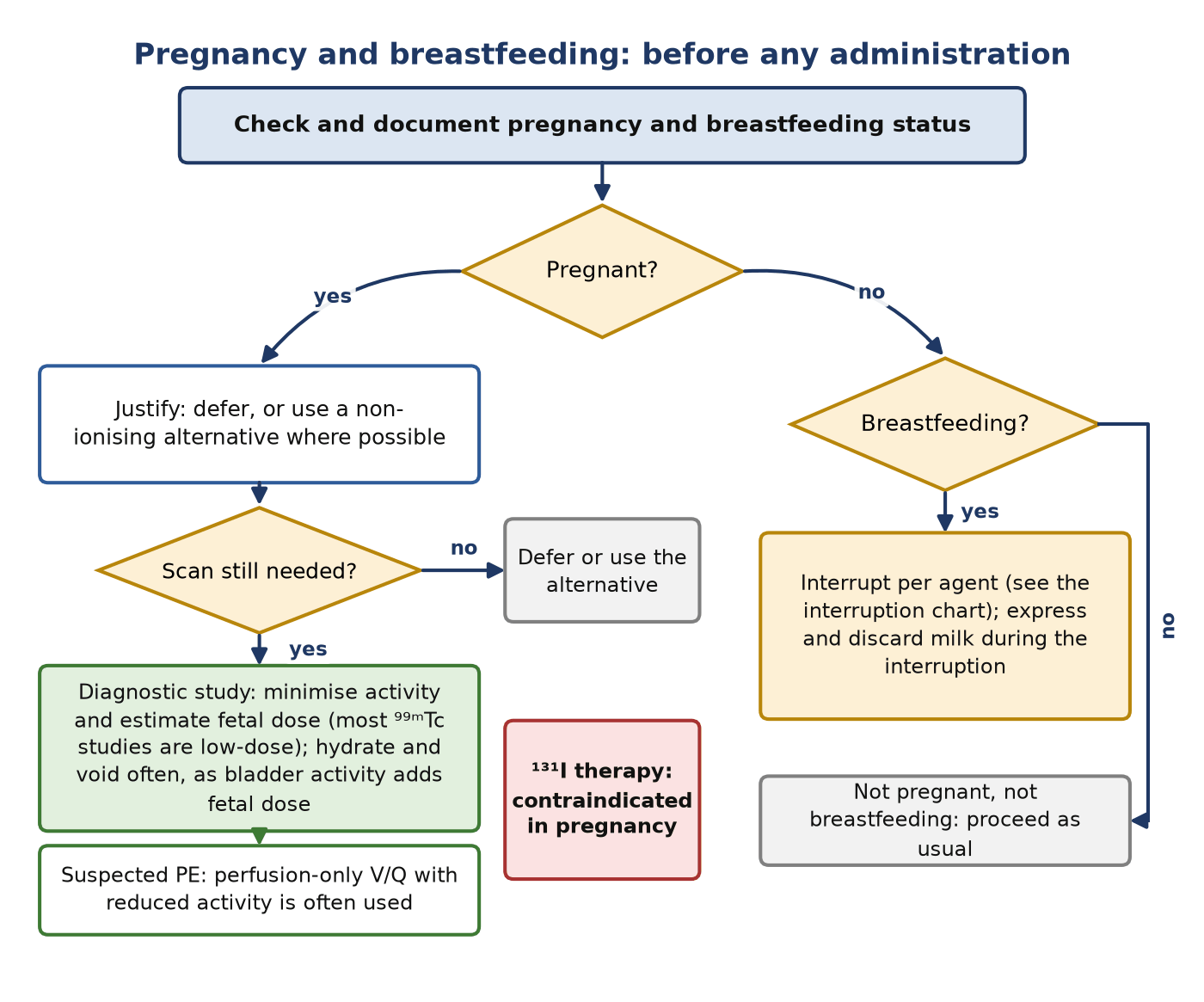
Radiopharmaceuticals reach the fetus by crossing the placenta and by irradiation from maternal organs, above all the bladder, and many enter breast milk. Most diagnostic studies give fetal doses of a few milligray or less, far below the 100 mGy below which radiation risk is not a reason to end a pregnancy. Radioiodine is the exception: the fetal thyroid concentrates iodide from 10–12 weeks' gestation, ¹³¹I therapy is contraindicated in pregnancy, and ¹³¹I requires breastfeeding to stop for that child. Breastfeeding advice for other agents differs sharply between ICRP, UK and US guidance.
Every study in a known or possible pregnancy needs justification by the practitioner, ideally with the referring team, and optimisation that does not compromise the diagnosis. A study that benefits the mother often benefits the fetus indirectly. For a lactating patient, choose the tracer and timing with milk excretion in mind, and give written, agent-specific instructions that are recorded in the notes.
- Uterus dose at UK reference activities (ARSAC 2026, early pregnancy, no placental transfer): ⁹⁹ᵐTc-MAA 100 MBq 0.2 mGy; ⁹⁹ᵐTc-MAG3 100 MBq 1.2 mGy; ⁹⁹ᵐTc-pertechnetate 400 MBq (Meckel's) 3 mGy; ⁹⁹ᵐTc-phosphonate 600 MBq 3.7 mGy; ¹⁸F-FDG 3.5 MBq/kg 4.4 mGy.
- Risk scale: a fetal dose of 1 mGy corresponds to a childhood cancer risk of about 1 in 17,000 (ICRP 84, as quoted by ARSAC); below 100 mGy, radiation risk does not justify termination; 100–500 mGy, decide individually.
- Fetal thyroid: takes up iodide from 8–10 weeks after conception; in the second and third trimesters the maternal body content should not exceed 0.03 MBq of ¹³¹I or 0.1 MBq of ¹²⁵I (ARSAC).
- Avoid pregnancy after ¹³¹I-iodide or ¹³¹I-mIBG therapy: 4 months (ARSAC); 6–12 months (ATA 2015). ⁸⁹Sr 24 months; ³²P 3 months; ¹⁵³Sm-EDTMP 1 month (ARSAC).
- Breastfeeding dose criterion: infant dose <1 mSv (ICRP; ARSAC, which also counts close-contact external dose; NRC durations). US reporting threshold for a nursing child: >50 mSv (10 CFR 35.3047).
- Before ¹³¹I therapy: stop breastfeeding or pumping at least 3 months beforehand (ATA 2015); lactating breast receives about 20 times the non-lactating breast dose from ¹³¹I (ICRP 95, via ARSAC).
Pregnancy: identify and justify
- UK: IR(ME)R requires every employer to have a written procedure for establishing pregnancy and breastfeeding status, with a stated age range (ARSAC gives 12–55 years as an example) and inclusive wording. The answers are documented.
- Graded approach for diagnostic studies (ARSAC): where the fetal dose would be below 10 mGy, ask whether the period is overdue and test if it is. Where it would exceed 10 mGy, perform the study only in the first 10 days of the menstrual cycle.
- Therapy: menstrual history alone is not enough; a pregnancy test is required and recorded, with reasonable exceptions such as intra-articular treatments.
- If a patient is or may be pregnant, the practitioner decides on justification with the multidisciplinary team; alternatives without ionising radiation are considered first.
Reducing fetal dose
- Use the lowest activity that keeps the diagnostic outcome, lengthening acquisition time rather than risking a non-diagnostic study.
- For renally excreted tracers, the maternal bladder is the main fetal dose source: encourage 1–2 L of extra fluid and frequent voiding for 1–2 days.
- Suspected pulmonary embolism: perfusion-only SPECT with 50 MBq ⁹⁹ᵐTc-MAA on day 1, with ventilation on day 2 only if needed; after the first trimester the standard 1-day protocol may be considered (EANM 2019). See PE in pregnancy.
- Radioiodide given before pregnancy was recognised: if it is found within 12 h, repeated oral potassium iodide (60–130 mg) to the mother may reduce the fetal thyroid dose.
- ¹³¹I therapy is absolutely contraindicated in pregnancy: fetal thyroid doses of several hundred gray can ablate the gland.
Breastfeeding: how to interrupt
- Before the study: express and store at least one feed if possible, and feed the infant just before the administration (ARSAC).
- At the next feed, or 3 h after administration if sooner, express as much milk as possible. Discard it, or freeze it and keep it until it has decayed. Continue expressing regularly during the interruption.
- Even where the interruption time is zero, expressing and discarding one feed is appropriate under ALARP.
- The published times assume intravenous injection and mature milk. In early lactation (colostrum), measure milk samples before resuming. Interstitial or eye-drop routes may need no interruption.
- Close contact matters as well as ingestion. UK guidance singles out patients who give most of the close care to a baby after more than 10 MBq ¹¹¹In-leucocytes, 150 MBq ²⁰¹Tl, 800 MBq ⁹⁹ᵐTc myocardial perfusion agent or 400 MBq ¹⁸F-FDG. ¹²³I should be given to a breastfeeding patient only if it is free of ¹²⁴I and ¹²⁵I.
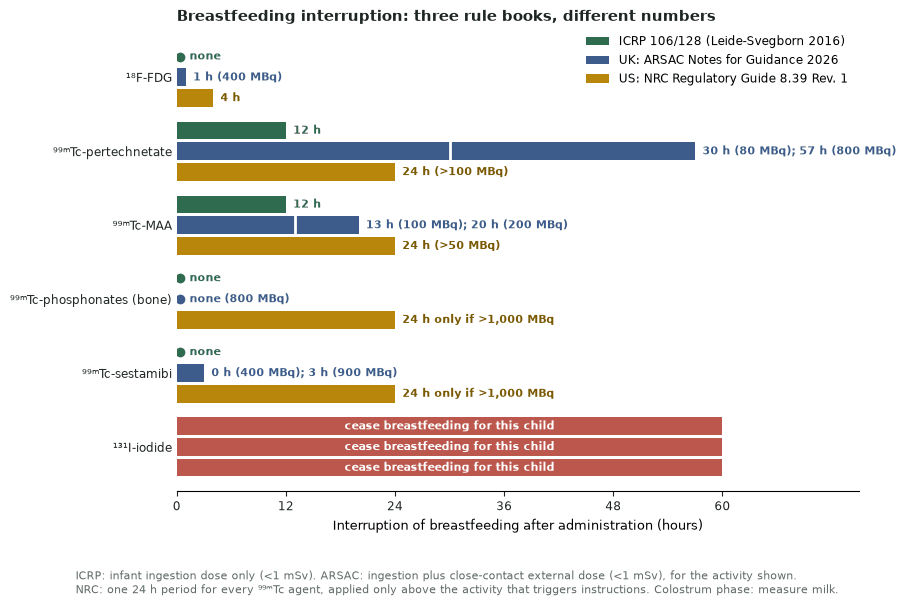
Interruption by agent: three rule books
| Agent | ICRP 106/128 | UK: ARSAC 2026 (activity given) | US: NRC RG 8.39 Rev. 1 |
|---|---|---|---|
| ¹⁸F-FDG | None | 1 h (400 MBq) | 4 h |
| ⁹⁹ᵐTc-pertechnetate | 12 h | 30 h (80 MBq); 57 h (800 MBq) | 24 h if >100 MBq |
| ⁹⁹ᵐTc-MAA | 12 h | 13 h (100 MBq); 20 h (200 MBq) | 24 h if >50 MBq |
| ⁹⁹ᵐTc-phosphonates | None | None (800 MBq) | 24 h if >1,000 MBq |
| ⁹⁹ᵐTc-MAG3 | None | None (100 MBq); 2 h (200 MBq) | 24 h if >1,000 MBq |
| ⁹⁹ᵐTc-sestamibi | None | None (400 MBq); 3 h (900 MBq) | 24 h if >1,000 MBq |
| ¹²³I-mIBG | — | 27 h (400 MBq) | 24 h for 370 MBq |
| ¹²³I-iodide | — | 42 h (20 MBq) | 3 days if >20 MBq |
| ²⁰¹Tl-chloride | 48 h | 10 h (80 MBq) | 4 days if >40 MBq |
| ¹³¹I-iodide | Cease | Cease | Cease |
| ¹⁷⁷Lu radioligands | Cease (all therapies) | Contraindicated (therapy) | Cease |
ICRP counts only the infant's ingestion dose. ARSAC adds external dose from close contact, which explains its longer times for pertechnetate and MAA. The NRC uses one 24-h period for every ⁹⁹ᵐTc agent to keep the advice simple, and asks for it only above the activity that triggers instructions.
Therapy and lactation
- Breastfeeding is contraindicated after therapeutic radiopharmaceuticals that enter milk; after ¹³¹I it must stop completely for the current child, but can resume after a later pregnancy.
- Even after breastfeeding stops, the lactating breast concentrates ¹³¹I-iodide: about 1.3 × 10⁻⁹ Sv/Bq, roughly 20 times the non-lactating breast. The ATA advises deferring therapy until at least 3 months after breastfeeding or pumping stops; involution of lactation can take more than 8 weeks, and a lactation specialist helps weigh the delay against lactation-suppressing drugs (ARSAC).
- See thyroid cancer for the wider radioiodine pathway.
Pitfalls
- Not asking about pregnancy or breastfeeding before the dose is drawn up.
- Forgetting the bladder as the main fetal dose source.
- Applying one generic interruption time, or quoting one country's table to a patient treated under another's rules.
- Missing the colostrum phase, when published interruption times do not apply.
In depth
- Leide-Svegborn et al. measured milk from 53 women after 16 radiopharmaceuticals. Of the administered activity, 19% of ⁹⁹ᵐTc-pertechnetate and 48% of ¹³¹I-iodide appeared in milk. The infant effective dose per MBq given to the mother was 3.6 × 10⁻² mSv/MBq for pertechnetate and 106 mSv/MBq for ¹³¹I-iodide.
- ARSAC's interruption times include a close-contact model: 35 min of contact at the start of each hour for 8 h, every fourth hour overnight, then hourly, totalling 9 h a day. The resulting effective exposure time is 1.8 h for FDG, 3.9 h for any ⁹⁹ᵐTc compound and 27.4 h for ¹³¹I-iodide in a euthyroid patient.
- The NRC durations are set to keep the maximum infant dose below 1 mSv, although the regulatory limit for release is 5 mSv. Instructions are required above the activity in Column 1 of RG 8.39 Table 3, and a record above Column 2.
- The EANM FDG guideline notes that the ICRP does not recommend interrupting breastfeeding after FDG, but suggests limiting mother–infant contact for 12 h because of external dose.
- The EANM mIBG guideline advises stopping breastfeeding for at least 48 h after ¹²³I-mIBG and permanently after ¹³¹I-mIBG, longer than ARSAC's 27 h at 400 MBq.
- ARSAC advises men to avoid fathering a child for 4 months after ¹³¹I-iodide, ³²P, ²²³Ra or ⁸⁹Sr, longer than the life cycle of a sperm cell. Pre-conceptual irradiation has not been shown to cause abnormalities in children, so no such advice is needed after routine diagnostic studies.
- US reporting: a dose to an embryo or fetus above 50 mSv, unless specifically approved in advance by the authorised user, must be reported to the NRC by the next calendar day. The same applies to a nursing child above 50 mSv or with unintended permanent functional damage (10 CFR 35.3047).
Sources: Leide-Svegborn 2016 (PMID 26732471) · Mattsson 2021 (PMID 33855370) · ARSAC Notes for Guidance (July 2026), section 7 · NRC RG 8.39 Rev. 1 (2020) · EANM FDG v2.0 (PMID 25452219) · EANM mIBG 2010 (PMID 20644928) · 10 CFR 35.3047
Sources
- International Commission on Radiological Protection. Pregnancy and medical radiation. ICRP Publication 84. Ann ICRP. 2000;30(1).
- International Commission on Radiological Protection. Radiation dose to patients from radiopharmaceuticals: a compendium of current information related to frequently used substances. ICRP Publication 128. Ann ICRP. 2015;44(2S).
- Leide-Svegborn S, Ahlgren L, Johansson L, Mattsson S. Excretion of radionuclides in human breast milk after nuclear medicine examinations: biokinetic and dosimetric data and recommendations on breastfeeding interruption. Eur J Nucl Med Mol Imaging. 2016;43:808–821.
- Mattsson S, Leide-Svegborn S, Andersson M. X-ray and molecular imaging during pregnancy and breastfeeding — when should we be worried? Radiat Prot Dosimetry. 2021;195:339–348.
- Administration of Radioactive Substances Advisory Committee. Notes for guidance on the clinical administration of radiopharmaceuticals and use of sealed radioactive sources. UK Health Security Agency; July 2026.
- US Nuclear Regulatory Commission. Release of patients administered radioactive material. Regulatory Guide 8.39, Revision 1. 2020.
- Bajc M, Schümichen C, Grüning T, et al. EANM guideline for ventilation/perfusion single-photon emission computed tomography (SPECT) for diagnosis of pulmonary embolism and beyond. Eur J Nucl Med Mol Imaging. 2019;46:2429–2451.
- Haugen BR, Alexander EK, Bible KC, et al. 2015 American Thyroid Association management guidelines for adult patients with thyroid nodules and differentiated thyroid cancer. Thyroid. 2016;26:1–133.
- Breathlessness at 11 weeks of pregnancy · Intermediate