Adrenal Medulla & Neural-Crest Imaging (MIBG)
¹²³I-MIBG images catecholamine-producing and neural-crest tumours — phaeochromocytoma, paraganglioma and neuroblastoma. It confirms functional tumour, maps metastatic (especially skeletal/marrow) disease, and identifies candidates for ¹³¹I-MIBG therapy. For phaeochromocytoma/paraganglioma the EANM/SNMMI 2019 guideline prefers PET for most indications: ¹⁸F-FDOPA for phaeochromocytoma and ⁶⁸Ga-SSTR (e.g. DOTATATE) PET for head-and-neck, extra-adrenal, multifocal, metastatic and SDHx-related disease; ¹²³I-MIBG is first-choice (with FDOPA) only for apparently sporadic phaeochromocytoma and remains essential before ¹³¹I-MIBG therapy.
MIBG is a noradrenaline analogue taken up and stored by chromaffin cells. Uptake indicates catecholaminergic tumour tissue and predicts response to ¹³¹I-MIBG therapy — another theranostic pairing.
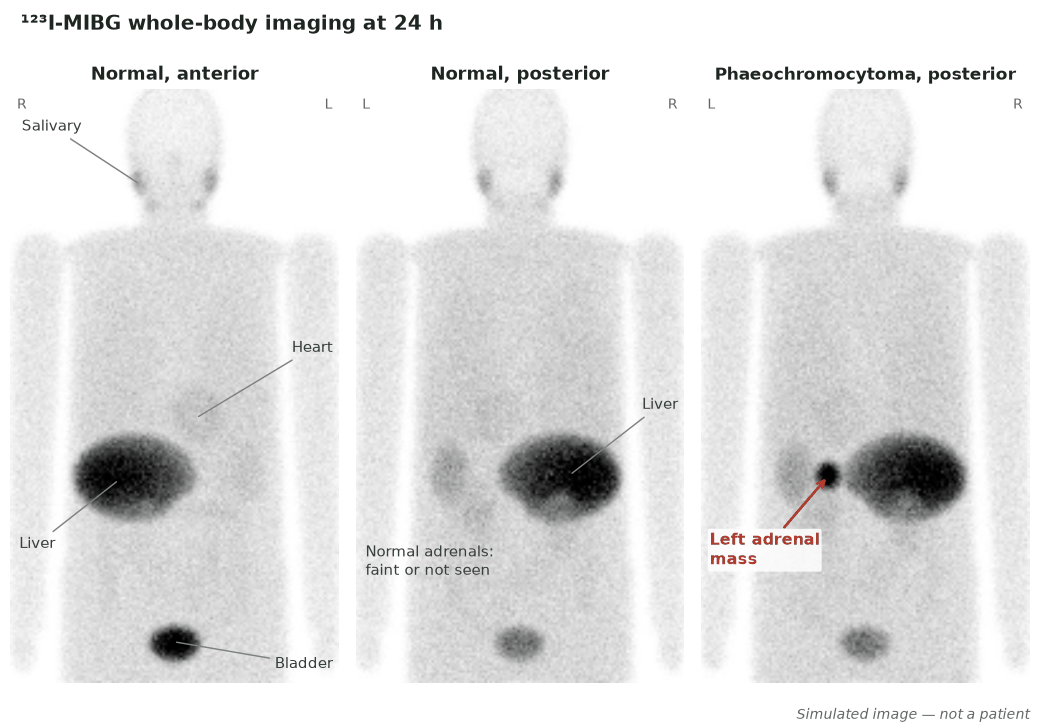
When to image
- Phaeochromocytoma/paraganglioma: selecting candidates for ¹³¹I-MIBG therapy, apparently sporadic phaeochromocytoma, or when ¹⁸F-FDOPA/SSTR PET is unavailable (sensitivity falls to ~52–75% in extra-adrenal, multifocal, recurrent and hereditary disease).
- Staging and response assessment in neuroblastoma (with semi-quantitative scoring).
- Detecting metastatic or recurrent catecholamine-producing tumours.
How to read it
- Focal uptake outside physiological sites indicates functional tumour.
- Assess skeletal/marrow and soft-tissue disease burden (scoring in neuroblastoma).
- Compare with anatomical imaging (CT/MRI) and DOTATATE where available.
Protocol
- Thyroid blockade; review and withhold interfering drugs where feasible.
- ¹²³I-MIBG (adult ~370 MBq; children 5.2 MBq/kg) planar/SPECT(-CT) at ~24 h (± 48 h).
- For paraganglioma (head-and-neck, extra-adrenal, metastatic or SDHx) use ⁶⁸Ga-SSTR PET first-line rather than MIBG.
Pitfalls
- Several drugs (labetalol, tricyclics, sympathomimetics) reduce uptake.
- Fewer than 50% of SDHB-related PPGLs are MIBG-positive and head-and-neck paraganglioma sensitivity is only 18–50% — MIBG should not be used for these; prefer ⁶⁸Ga-SSTR PET (FDG/FDOPA second line).
- Physiological uptake (salivary glands, liver, heart, faint normal adrenals, bowel, bladder).
Evidence & guidelines
- EANM/SNMMI 2019 PPGL imaging guideline (Taïeb et al., Eur J Nucl Med Mol Imaging 2019;46:2112–2137); EANM neuroblastoma imaging guideline (Bar-Sever et al., Eur J Nucl Med Mol Imaging 2018;45:2009–2024); SIOPEN scoring (Lewington et al., Eur J Nucl Med Mol Imaging 2017;44:234–241).
- MIBG avidity selects patients for ¹³¹I-MIBG therapy.
In depth
- MIBG is a guanethidine analogue taken up by the norepinephrine transporter (uptake-1) and stored in neurosecretory vesicles via VMAT1/2 in phaeochromocytoma; in neuroblastoma cells, which have few storage granules, it is held mainly in the cytoplasm by continuous re-uptake.
- ¹²³I-MIBG is preferred over ¹³¹I for diagnosis (shorter half-life, lower energy, better images, lower dose).
- ¹²³I-MIBG sensitivity is 83–100% for phaeochromocytoma, but only 18–50% for head and neck paraganglioma, and fewer than half of SDHB-related tumours are MIBG-positive.
- ⁶⁸Ga-DOTA-somatostatin analogue PET has a pooled detection rate of about 93% in PPGL, and EANM/SNMMI 2019 recommend it first for head and neck, extra-adrenal sympathetic, multifocal, metastatic and SDHx-related disease, whereas ¹⁸F-FDOPA or ¹²³I-MIBG is first choice for sporadic phaeochromocytoma.
- In polycythaemia-associated PGL, ⁶⁸Ga-DOTATATE detected only 35% vs 98.7% for ¹⁸F-FDOPA — tracer choice depends on genotype/phenotype.
- High-specific-activity ¹³¹I-MIBG (Azedra) was FDA-approved in July 2018 as the first approved systemic therapy for advanced phaeochromocytoma/paraganglioma, given as a dosimetric dose then two therapeutic doses of about 18.5 GBq (weight-adjusted in smaller patients); production was discontinued in 2023–24.
- The choice between ¹⁷⁷Lu-DOTATATE and ¹³¹I-MIBG therapy is individualised, favouring the tracer with stronger and more homogeneous uptake and taking marrow and renal reserve into account; both can cause cytopenias and catecholamine surges, and head-to-head data are lacking.
Sources: EANM/SNMMI PPGL imaging guideline 2019 (PMID 31254038) · Smets et al. Biochem Pharmacol 1990 (PMID 2353937) · Janssen et al. J Nucl Med 2017 (PMID 28336782) · Pryma et al. J Nucl Med 2019 (PMID 30291194) · FDA approval 30 July 2018 · Cancers 2025 review (PMC12650968) · Update on systemic therapies for metastatic PPGL, Cancers 2025 (PMC12650968)