Neuroendocrine Tumours (⁶⁸Ga-DOTATATE PET)
⁶⁸Ga-DOTATATE (or DOTATOC/DOTANOC) PET/CT images somatostatin receptors on well-differentiated neuroendocrine tumours, with pooled sensitivity and specificity ≈90% — superior to ¹¹¹In-octreotide and conventional imaging. It stages disease, finds unknown primaries, and selects patients for ¹⁷⁷Lu-DOTATATE peptide receptor radionuclide therapy (PRRT) — the theranostic pair.
Somatostatin-receptor density is high on differentiated NETs, so receptor PET gives excellent tumour-to-background contrast. Dedifferentiated, higher-grade tumours lose receptors and become FDG-avid instead.
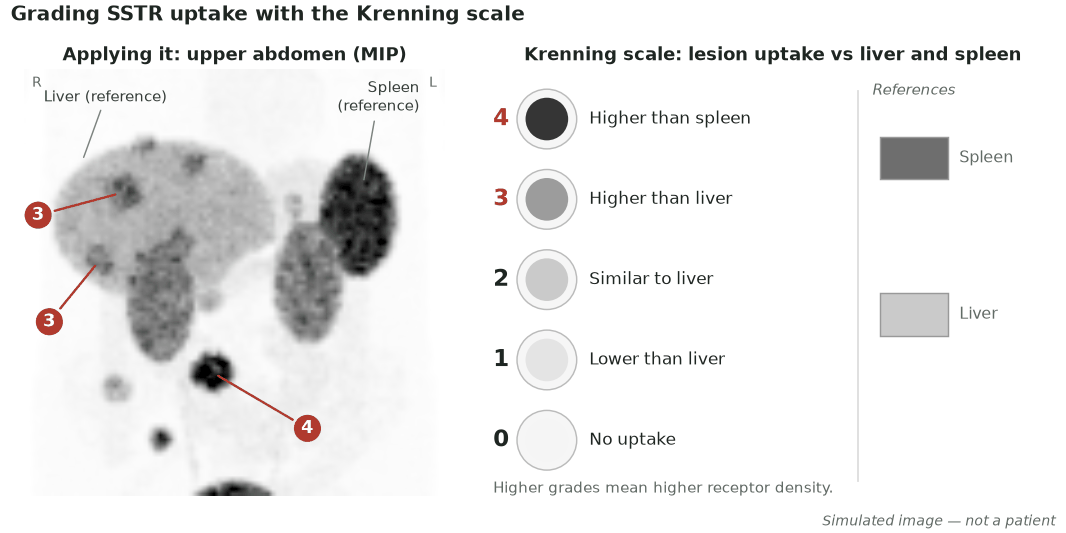
When to image
- Staging and restaging of well-differentiated neuroendocrine tumours.
- Localising an unknown primary in metastatic NET.
- Selecting and monitoring peptide receptor radionuclide therapy (PRRT).
How to read it
- Receptor-positive (DOTATATE-avid) lesions indicate well-differentiated, PRRT-eligible disease.
- Know physiological uptake (spleen, pancreatic uncinate, adrenals, pituitary) to avoid false positives.
- Discordant FDG-positive/DOTATATE-negative lesions suggest higher grade.
Protocol
- ⁶⁸Ga-DOTATATE PET/CT ~60 min after injection (acceptable window 40–90 min; ~2 MBq/kg, max 200 MBq).
- Schedule imaging just before the next long-acting somatostatin analogue dose (withholding is no longer considered essential); stop short-acting analogues 12 h before.
- Consider dual FDG/DOTATATE in higher-grade disease.
Diagnostic performance
Meta-analysis: pooled sensitivity ≈90% and specificity ≈90% for ⁶⁸Ga-DOTATATE in pulmonary and gastroenteropancreatic NETs — superior to ¹¹¹In-octreotide and conventional imaging.
Pitfalls
- Physiological uptake mimics disease (spleen, uncinate process, adrenals).
- Somatostatin analogues mainly lower normal-organ (spleen, liver) uptake; recent dosing has minimal effect on tumour uptake but image before the next dose for consistency.
- Low-grade uptake in poorly differentiated tumours — pair with FDG.
Evidence & guidelines
- Deppen et al., J Nucl Med 2016;57:872–878 (meta-analysis): ⁶⁸Ga-DOTATATE sensitivity 90.9%, specificity 90.6%; more sensitive than ¹¹¹In-octreotide.
- SNMMI/EANM SSTR PET procedure standard (Hope et al., J Nucl Med 2023;64:204–210); SSTR PET underpins the ⁶⁸Ga/¹⁷⁷Lu-DOTATATE theranostic pathway.
In depth
- ¹⁷⁷Lu-DOTATATE is DOTA-[Tyr³]octreotate labelled with ¹⁷⁷Lu, a β⁻ emitter with imageable γ photons (half-life 6.7 days, about 160 h; maximum tissue range about 2 mm), and causes less renal toxicity than ⁹⁰Y-labelled peptides.
- NETTER-1 (progressive SSTR-positive midgut NET): 20-month PFS 65.2% vs 10.8% for high-dose octreotide (79% lower risk of progression/death); ORR 18% vs 3%.
- Final NETTER-1 median OS 48.0 vs 36.3 months (HR 0.84) — an 11.7-month difference that was not statistically significant.
- NETTER-1 eligibility: inoperable, well-differentiated midgut NET with Ki-67 ≤20%, somatostatin receptor expression in all target lesions on OctreoScan, and RECIST 1.1 progression on a fixed dose of octreotide LAR.
- Renal exclusions: creatinine >1.7 mg/dL or clearance <50 mL/min; haematologic Hb <8 g/dL or platelets <75,000.
- With co-infused amino acids for renal protection, grade 3–4 neutropenia, thrombocytopenia and lymphopenia occurred in 1%, 2% and 9%, with no renal toxicity in the observed period; long-term follow-up found myelodysplastic syndrome in 2%.
- Lutathera is FDA-approved for SSTR-positive GEP-NETs in adults (2018) and in children aged 12 years and older (2024); PRRT developed from earlier high-activity ¹¹¹In-octreotide and ⁹⁰Y-DOTATOC treatment.
Sources: PMID 28076709 · FDA Lutathera label · PMID 28076709 (Strosberg 2017, NEJM) · PMID 34793718 (Strosberg 2021, Lancet Oncol) · ClinicalTrials.gov NCT01578239 · PMID 34793718 · FDA approval April 2024 (Novartis/NETRF)
- Flushing, diarrhoea and liver lesions · Intermediate