Cardiac Amyloidosis (Bone-Tracer Scintigraphy)
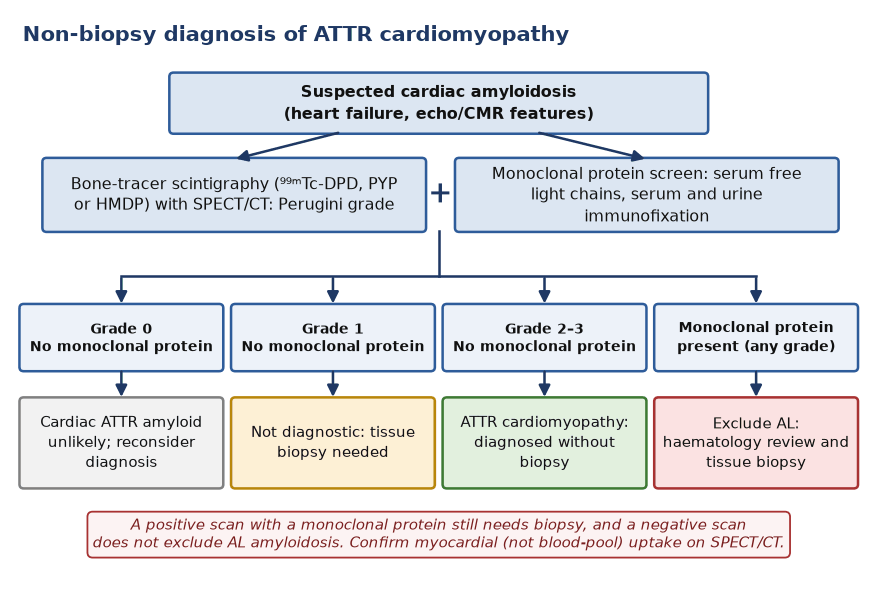
⁹⁹ᵐTc-PYP, -DPD and -HMDP localise to transthyretin (ATTR) cardiac amyloid. In a patient with echo or CMR features of amyloidosis, diffuse grade 2–3 myocardial uptake confirmed on SPECT, with no monoclonal protein on serum free light chains and serum and urine immunofixation, diagnoses ATTR cardiomyopathy without biopsy (specificity and PPV 100%; Gillmore 2016). The scan alone never diagnoses or excludes AL amyloidosis: grade 2–3 uptake occurs in more than 20% of AL cardiac amyloidosis.
Why bone tracers bind ATTR deposits is not fully understood (microcalcification is one proposed mechanism); ⁹⁹ᵐTc-MDP shows little or no cardiac uptake and is not used. ATTR is wild type (mostly older men) or hereditary (TTR variants, such as p.Val142Ile, formerly Val122Ile, carried by 3–4% of African Americans). Early diagnosis matters because TTR stabilisers and silencers improve outcomes.
- Activity: PYP, DPD or HMDP 370–740 MBq IV; no preparation. 555 MBq PYP ≈ 3.2 mSv.
- Imaging at 2 or 3 h (any agent); PYP may be imaged at 1 h, adding 3 h if blood pool persists. SPECT is required; 1-h planar-only imaging is not recommended.
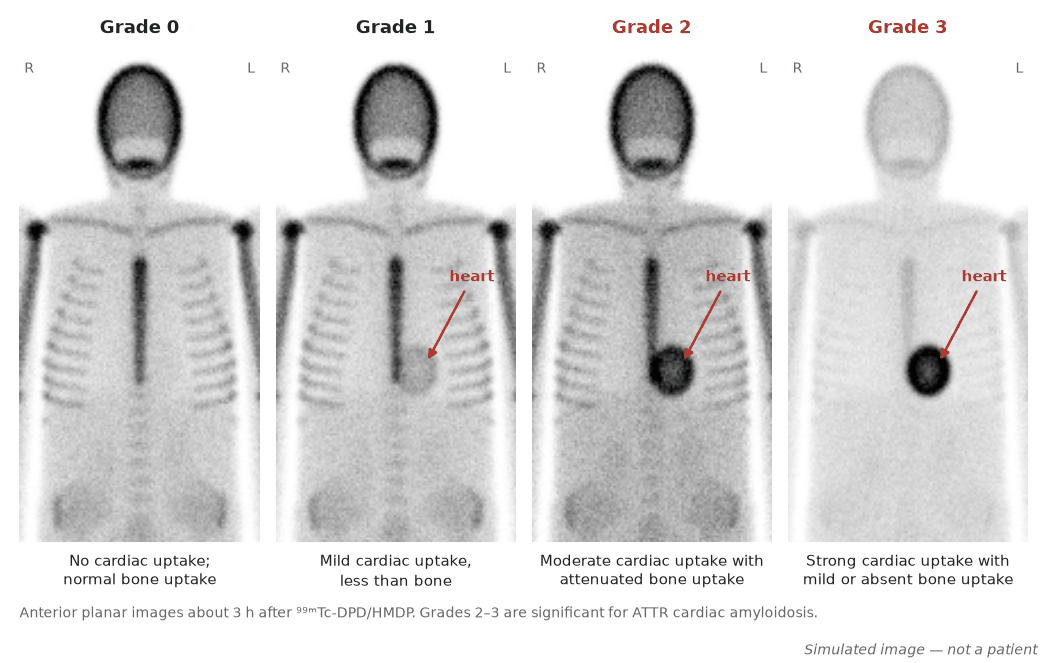
- Visual grade (myocardium v rib): 0 none; 1 less than rib; 2 equal to rib; 3 greater than rib with mild or absent rib uptake.
- H/CL (PYP): ≥ 1.5 at 1 h or ≥ 1.3 at 3 h supports ATTR only when SPECT confirms myocardial uptake.
- Gillmore 2016 (1217 patients): any myocardial uptake > 99% sensitive and 86% specific for ATTR; grade 2–3 with no monoclonal protein: specificity and PPV 100% (PPV 95% CI 98.0–100).
- Free light chains plus serum and urine immunofixation detect the AL precursor with about 99% sensitivity; with eGFR < 45, a κ/λ ratio up to 2.0 (3.1 on dialysis) with negative immunofixation is usually normal (ESC 2021).
When and how to image
- Heart failure with unexplained left-ventricular wall thickening (> 12 mm), especially over 60 years or with preserved ejection fraction.
- Red flags: bilateral carpal tunnel syndrome, lumbar spinal stenosis, ruptured biceps tendon, polyneuropathy or dysautonomia, low ECG voltage for the wall thickness, conduction disease, and diffuse late gadolinium enhancement on CMR.
- Known TTR variant carriers and relatives of patients with hereditary ATTR.
- Suspected amyloid when CMR is not possible (device, renal failure).
- Anterior and lateral planar chest views, then SPECT (SPECT/CT preferred) of the heart to separate myocardium from blood pool and overlying rib.
- Whole-body planar imaging is optional; soft-tissue uptake in the shoulder and hip girdles is a sign of systemic ATTR.
- Request serum free light chains and serum and urine immunofixation at the same time; serum electrophoresis alone is not enough.
How to read it
- Step 1, SPECT: is there diffuse myocardial uptake? Separate it from blood pool, a regional infarct and rib hot spots. No myocardial uptake on SPECT means grade 0, whatever the planar image shows.
- Step 2, grade against rib on planar and SPECT images.
- Step 3, H/CL (optional): a circular heart region mirrored to the contralateral chest, both above the diaphragm and clear of the sternum; useful mainly for grade 1 v 2 uncertainty.
- Conclude: not suggestive (grade 0), equivocal (diffuse grade 1 or grade 1 v 2 uncertainty) or strongly suggestive (diffuse grade 2–3) of ATTR, always with the statement that AL must be excluded; use the cardiac amyloid reporting template.
- Regional rather than diffuse uptake suggests another cause, such as recent infarction.
From scan to diagnosis
- Grade 2–3, no monoclonal protein, compatible echo/CMR: ATTR cardiomyopathy without biopsy. Offer TTR gene sequencing and genetic counselling to every patient, whatever their age.
- Any monoclonal protein: urgent haematology review and tissue biopsy with amyloid typing (mass spectrometry is the reference; immunohistochemistry or immunoelectron microscopy in specialist centres). A monoclonal gammopathy and ATTR can coexist in older patients.
- Grade 1: a non-invasive diagnosis is not possible; histology is needed.
- Grade 0 with strong clinical suspicion: CMR and/or biopsy, because AL and some variants can be scan-negative.
- AL is a haematological emergency treated against the plasma-cell clone; ATTR is treated with TTR-directed drugs.
Treatment context
- Tafamidis (stabiliser; ATTR-ACT, 441 patients): all-cause death 29.5% v 42.9% over 30 months (HR 0.70) and fewer cardiovascular admissions.
- Acoramidis (stabiliser; ATTRibute-CM, 632 patients): hierarchical outcome of death, admissions, NT-proBNP and walk distance favoured acoramidis (win ratio 1.8); US approval November 2024.
- Vutrisiran (RNA-interference silencer, 25 mg subcutaneously every 12 weeks; HELIOS-B, 655 patients): death or recurrent cardiovascular events HR 0.72; US approval for ATTR cardiomyopathy March 2025.
- Approvals and funding differ between the US, EU and UK. Bone scintigraphy has limited value for monitoring response.
PET amyloid tracers
- ¹¹C-PiB, ¹⁸F-florbetapir and ¹⁸F-florbetaben bind the amyloid fibril itself, so they show AL as well as ATTR deposits, where bone tracers fail in AL; a 2026 meta-analysis (20 studies, 577 patients) found sensitivity 0.91 and specificity 0.90. They do not reliably type the amyloid, and their cardiac use is off-label or research-only.
- ¹²⁴I-evuzamitide, a pan-amyloid peptide, is investigational: in the phase 3 REVEAL study (170 patients, 18 US centres; 37 MBq, imaged at 3–5 h under potassium iodide blockade) sensitivity was 94% and specificity 86%.
Pitfalls
- False positives: AL amyloidosis; rarer types (AApoAI, AApoAII, AApoAIV, Aβ2M); hydroxychloroquine cardiotoxicity; recent infarction; blood pool; rib fractures and valve calcification.
- False negatives: very mild disease; imaging too early or too late; the variants p.Phe84Leu and p.Ser97Tyr (formerly Phe64Leu and Ser77Tyr).
- Never diagnose ATTR from H/CL or planar images alone, or without the full monoclonal screen.
In depth
- Perugini 2005: ⁹⁹ᵐTc-DPD uptake in all 15 ATTR patients and none of 10 AL patients; 11 DPD-positive patients imaged with ⁹⁹ᵐTc-MDP all scored 0.
- Gillmore 2016 studied 857 patients with proven amyloid (374 endomyocardial biopsies) and 360 without; false positives were almost all AL, which is why the rule needs both grade 2–3 and a negative monoclonal screen.
- The ASNC 2021 update and the multisociety addendum require SPECT in every study and advise against 1-h planar-only imaging, because blood-pool activity can mimic myocardial uptake and raise H/CL.
- Variant naming: current HGVS numbering adds the 20-residue signal peptide, so Val122Ile is p.Val142Ile and Phe64Leu is p.Phe84Leu.
- In chronic kidney disease, free light chains are cleared less, so the κ/λ ratio rises; ESC 2021 accepts up to 2.0 (3.1 on dialysis) if immunofixation is negative.
- Tafamidis and acoramidis stabilise the TTR tetramer; vutrisiran lowers hepatic TTR production.
Sources: Perugini 2005 (PMID 16168294) · Gillmore 2016 (PMID 27143678) · Dorbala 2021 addendum (PMID 34196911) · ESC 2021 (PMID 33825853) · ASNC practice points, PYP (2021 update)
Sources
- Gillmore JD, Maurer MS, Falk RH, et al. Nonbiopsy diagnosis of cardiac transthyretin amyloidosis. Circulation. 2016;133:2404–12.
- Perugini E, Guidalotti PL, Salvi F, et al. Noninvasive etiologic diagnosis of cardiac amyloidosis using ⁹⁹ᵐTc-DPD scintigraphy. J Am Coll Cardiol. 2005;46:1076–84.
- Dorbala S, Ando Y, Bokhari S, et al. ASNC/AHA/ASE/EANM/HFSA/ISA/SCMR/SNMMI expert consensus recommendations for multimodality imaging in cardiac amyloidosis: part 1 of 2. J Nucl Cardiol. 2019;26:2065–123; addendum 2021;28:1769–74.
- Garcia-Pavia P, Rapezzi C, Adler Y, et al. Diagnosis and treatment of cardiac amyloidosis: a position statement of the ESC Working Group on Myocardial and Pericardial Diseases. Eur Heart J. 2021;42:1554–68.
- American Society of Nuclear Cardiology. Cardiac amyloidosis practice points: ⁹⁹ᵐTc-pyrophosphate imaging for transthyretin cardiac amyloidosis. Update 2021.
- Maurer MS, Schwartz JH, Gundapaneni B, et al. Tafamidis treatment for patients with transthyretin amyloid cardiomyopathy. N Engl J Med. 2018;379:1007–16.
- Gillmore JD, Judge DP, Cappelli F, et al. Efficacy and safety of acoramidis in transthyretin amyloid cardiomyopathy. N Engl J Med. 2024;390:132–42.
- Fontana M, Berk JL, Gillmore JD, et al. Vutrisiran in patients with transthyretin amyloidosis with cardiomyopathy. N Engl J Med. 2025;392:33–44.
- Dorbala S, Maurer MS, Cuddy SAM, et al. ¹²⁴I-evuzamitide PET/CT for diagnosing cardiac amyloidosis: the REVEAL nonrandomized clinical trial. JAMA. 2026.
- Breathlessness and a thick heart in a 79-year-old man · Intermediate