Salivary Gland Scintigraphy
Snapshot
⁹⁹ᵐTc-pertechnetate salivary scintigraphy assesses salivary-gland function and ductal patency. It quantifies trapping and stimulated excretion (e.g. after a lemon-juice/citric-acid stimulus), and is useful in Sjögren’s syndrome, post-radioiodine or post-radiotherapy xerostomia, and suspected ductal obstruction.
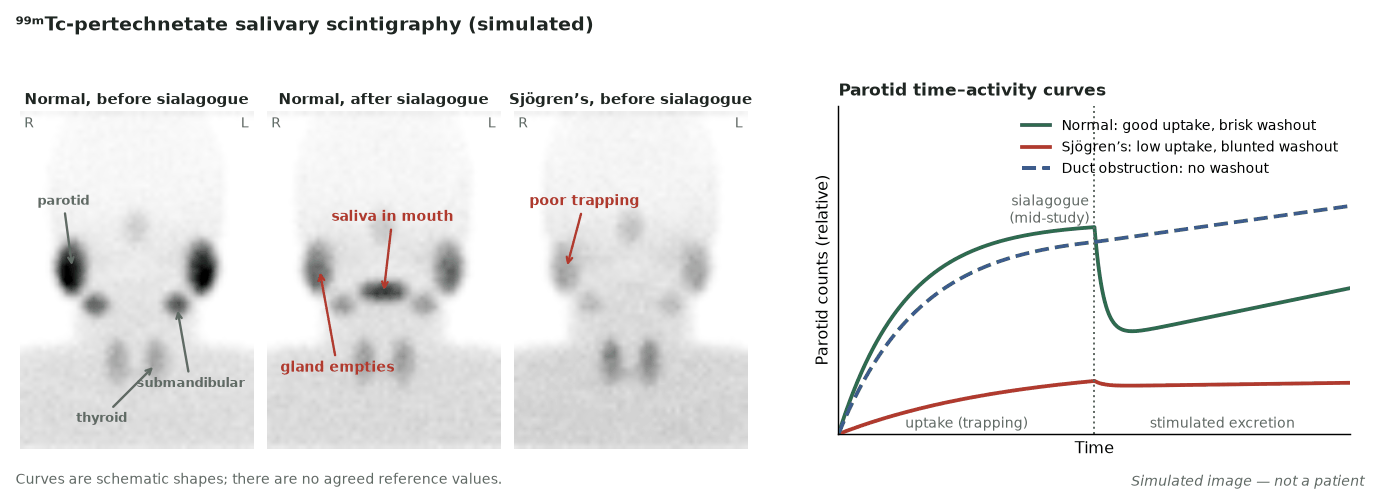
Pertechnetate is trapped and secreted by the salivary glands much as by the thyroid, so dynamic imaging shows uptake into each gland and washout into the mouth after a sialagogue — a functional map of secretory capacity and drainage.
PertechnetateGland function
Sjögren’s↓ uptake & excretion
SialagogueStimulated washout
When to image
- Assessing gland function in Sjögren’s syndrome and other causes of dry mouth.
- Quantifying xerostomia after radioiodine therapy or head-and-neck radiotherapy.
- Evaluating suspected ductal obstruction or a non-functioning gland.
How to read it
- Reduced trapping and blunted post-stimulation washout indicate hypofunction (e.g. Sjögren’s).
- Delayed or absent excretion after a sialagogue suggests obstruction.
- Compare the four major glands for asymmetry.
Protocol
- Dynamic acquisition after ⁹⁹ᵐTc-pertechnetate; sialagogue (lemon juice/citric acid) mid-study.
- Generate time–activity curves for each gland (uptake and excretion fractions).
Pitfalls
- Recent thyroid/iodine studies and medications affect trapping.
- Poor stimulus delivery blunts the washout phase.
- Interpret with clinical and serological context — scintigraphy is not part of the 2016 ACR/EULAR Sjögren’s classification criteria.
Evidence & guidelines
- There is no joint EANM/SNMMI salivary guideline; protocols and reference values remain unstandardised (Chen et al., Diagnostics 2021;11:1173). Semiquantitative uptake/washout method: Loutfi et al., J Nucl Med Technol 2003;31:81–85.
- A functional complement to ultrasound and sialography.
In depth
- Bolus IV 185 MBq (5 mCi) ⁹⁹ᵐTc-pertechnetate with dynamic head-and-neck imaging 1 frame/30 s for 30 min.
- Give a sialagogue (lemon juice) at 15 min to stimulate excretion.
- Time-activity curves rise to a near-plateau by 6–10 min, with washout immediately after the sialagogue.
- The uptake rate, the initial slope of the time–activity curve over the first 240 s, reflects extraction from blood, and the washout fraction after the sialagogue reflects excretion.
- In one semiquantitative series, parotid uptake was about 1.5–2 times submandibular uptake and parotid washout exceeded submandibular washout.
- In Sjögren's syndrome both uptake and sialagogue-induced washout fall, and impaired washout can be seen while uptake is still preserved, so excretion indices are useful to assess.
- Normal thyroid trapping of pertechnetate is only about 0.7–3% of the dose, so it has little effect on salivary quantitation, although uptake can be much higher in hyperthyroidism.
Sources: PMID 12777459 (Loutfi 2003, J Nucl Med Technol) · PMID 12777459
Spotted an error or something out of date? Report an error