Amyloid & Tau PET
Amyloid PET (florbetapir, flutemetamol, florbetaben) images fibrillar β-amyloid — a core feature of Alzheimer’s disease. Its greatest value is a negative scan, which makes significant amyloid pathology, and therefore Alzheimer’s, very unlikely. Tau PET maps neurofibrillary tau, which tracks disease stage and topography more closely than amyloid. Both are used within appropriate-use criteria, not as stand-alone screening tests.
Alzheimer pathology combines β-amyloid plaques and neurofibrillary tau tangles. Amyloid accumulates early and plateaus; tau accumulates later and correlates with symptoms — so the two tracers answer different questions.
When to image
- Persistent or progressive unexplained cognitive impairment where Alzheimer pathology is in question.
- Atypical or early-onset presentations.
- Distinguishing Alzheimer’s from non-amyloid causes of dementia.
- Within appropriate-use criteria — not for screening asymptomatic people.
How to read it
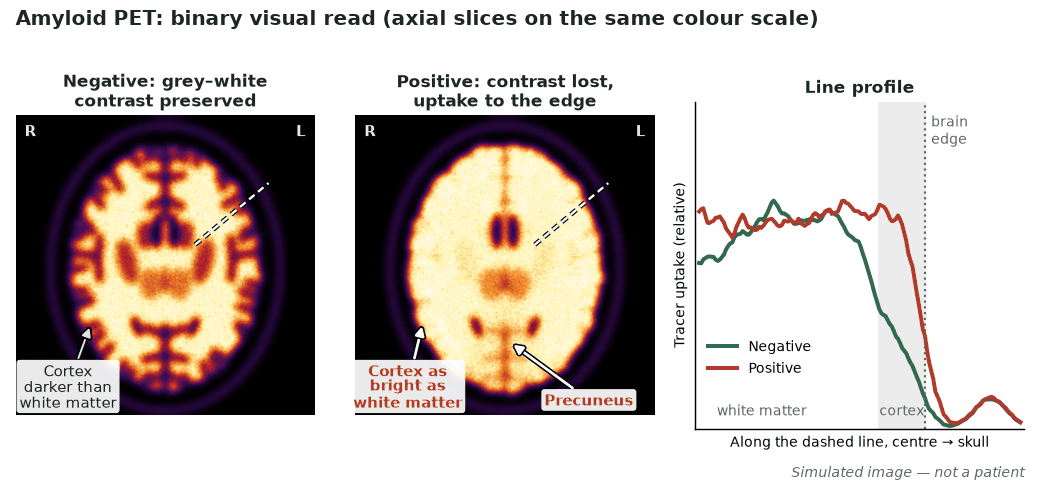
- Amyloid: cortical tracer retention (loss of grey–white contrast) = positive; a negative scan argues strongly against AD.
- Tau: uptake follows Braak-like topography and correlates with clinical stage.
- Interpret alongside FDG pattern, MRI and clinical data.
Protocol
- Standard brain PET acquisition at the tracer-specific uptake time.
- Binary visual read (positive/negative) per approved criteria; quantification (e.g. Centiloids) supports borderline cases.
Diagnostic performance
- Amyloid PET shows high concordance with neuropathological amyloid (broadly ≈90%).
- A negative amyloid scan has a high negative predictive value for Alzheimer’s.
- Tau PET adds staging and prognostic information.
Pitfalls
- Amyloid positivity increases with age and can occur in cognitively normal people — positivity ≠ dementia.
- Amyloid status does not by itself establish the cause of symptoms.
- Some tau tracers show off-target binding.
Evidence & guidelines
- Amyloid Imaging Task Force/SNMMI/Alzheimer’s Association Appropriate Use Criteria for amyloid PET (Johnson et al., 2013), updated for amyloid and tau PET by Rabinovici et al. (2025).
- Amyloid and tau PET are increasingly used to confirm Alzheimer biology, including for disease-modifying therapy pathways.
In depth
- Approved amyloid tracers are the ¹⁸F agents florbetapir, florbetaben and flutemetamol; ¹¹C-Pittsburgh compound B (PiB) is used in research.
- Under the Alzheimer’s Association/SNMMI appropriate-use criteria (updated 2025), amyloid PET is appropriate in MCI or dementia where AD is suspected, in young-onset (under 65) and atypical presentations, and to confirm amyloid before anti-amyloid therapy.
- On visual read, a positive scan shows tracer retention extending into neocortical grey matter with loss of grey–white contrast (earliest in the posterior cingulate, precuneus and frontal regions); a negative scan shows only non-specific white-matter retention.
- Neocortical amyloid burden is quantified as a standardised uptake value ratio (SUVR) against a reference region such as the cerebellum, and harmonised across tracers on the Centiloid scale (0 = young amyloid-negative controls, 100 = typical mild–moderate AD dementia).
- Behavioural-variant FTD is generally amyloid-negative, while cerebral amyloid angiopathy and logopenic aphasia are generally amyloid-positive.
- Amyloid PET is a pathology biomarker that complements neuronal-injury markers; under the 2011 NIA-AA criteria their combination graded MCI as having high, intermediate or unlikely likelihood of being due to AD, and the 2024 Alzheimer’s Association criteria accept an abnormal amyloid PET alone as sufficient to diagnose AD biologically.
- Tau PET (¹⁸F-flortaucipir, FDA-approved in 2020) now maps neurofibrillary tangle density and distribution, and α-synuclein PET tracers remain in early development; together they should further separate the pathological hallmarks of the dementias.
Sources: Alzheimer's Association/SNMMI amyloid and tau PET AUC 2025 (PMID 39778970) · Johnson et al. J Nucl Med 2013 (PMID 23359661) · Albert et al. NIA-AA MCI criteria 2011 (PMID 21514249) · Jack et al. revised AA criteria 2024 (PMID 38934362)